Scan to play on mobile
Devil Die
How to Play
Game Overview
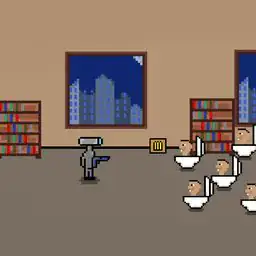
Devil Die is one of those games that starts off looking like a cheerful little platformer, all pastel colors and a tiny pixel hero who hops around like nothing bad ever happens. Then you step on a platform that flips upside down, and a saw blade shoots out of a wall you thought was solid. The vibe shifts real quick. Visually it''s cute in a retro way, with chunky sprites and simple backgrounds, but the whole point is that nothing is trustworthy. Every level is a short corridor leading to an exit door, and that door might be a fake. The floor might drop. The spikes might appear exactly where you land. It feels like playing a prank that keeps escalating. Controls are just left, right, and jump, so you can''t blame the input. The game wants you to die, over and over, and it''s funny for a while until it''s frustrating, then funny again. There''s no story, no upgrades, no power-ups--just trial and error with a mean sense of humor. The people who get hooked are the ones who laugh at their own deaths and keep trying because each level is short enough to retry instantly. It''s not about skill as much as memory and patience. If you liked games like The Floor is Lava or I Wanna Be the Guy, this is that same spirit in a smaller, faster package.
About Devil Die
So you're this tiny pixel guy, right? The goal is dead simple in every level: just get to the exit door. You've got left, right, and jump -- that's it. But here's the kicker: the game lies to you constantly. Level 1-1 is all cheerful and safe, green platforms, a door that's clearly the goal. You reach it, you win. Then 1-2 has a floor tile that crumbles under you, and you're like "oh okay, watch for that." By 1-5 there are spikes that pop out of walls with zero warning, and you've already died like twenty times.
The loop is quick and brutal. You die, you're back at the start of that level in under a second. No loading, no menu, just respawn and try again. Your brain starts working overtime -- you're not just running right, you're testing every tile with a quick tap, watching for the slightest visual clue. Some traps are obvious: a saw blade that moves in a pattern, a gap you gotta jump over. But the nasty ones are the fake floors, the doors that actually kill you, and the switches that reverse your controls for a few seconds. That last one is pure evil in later levels like "Deception Alley" or "Trust No One."
Difficulty ramps up by introducing mechanics one at a time. First it's falling platforms. Then spike traps. Then moving walls that crush you. Around world 3 you get teleporters that send you to random spots, and world 4 has these gravity zones that flip your jump direction. There's no upgrade system -- you don't get stronger or unlock new moves. The only thing that changes is you getting smarter. And that's actually satisfying. When you nail a level that took you fifty tries, it feels earned because the game never cheats -- it just hides its tricks well.
Later levels like "The Gauntlet" combine everything: crumbling floors over a pit of spikes, with a saw blade chasing you from behind, and a fake safe zone that drops you into a trap. You have to memorize the pattern, then execute it perfectly. The game doesn't hold your hand, but it also doesn't waste your time. The pixel art stays cute the whole time, which makes the sudden traps even funnier. There's a level called "Friend or Foe" where every single door is a trap except one, and you figure it out by watching the shadow flicker. That's the kind of detail you start noticing.
Your hands are just tapping left, right, jump, but your brain is building a mental map of every level's lies. The satisfying part is when you stop dying to the same trick and start predicting what the game will throw at you next. And then it throws something new anyway.
Tips & Tricks
The first thing you''ll learn is that the floor you walk on is never trustworthy. I lost count of how many times I ran straight into a pit because I assumed the ground was solid. A good habit is to tap the jump button slightly before you reach a surface that looks even a little off -- the game loves to make safe-looking platforms vanish the instant you land on them.
Spikes that pop out of walls have a tiny tell: a faint crack or a color shift on the wall tile. It''s subtle, but once you notice it, you can time your jump or dash past before they extend. I spent way too long dying to those because I was staring at the door instead of the walls.
When you see a door that seems too easy to reach, it''s almost certainly a fake. The real exit is usually hidden behind a false wall or requires you to backtrack after flipping a switch. Don''t sprint for the first door you see -- check the level layout first.
Reversed controls will mess you up hard if you panic. When that effect kicks in, just stop moving for a second. Take a breath, then mentally swap left and right. It''s better to move slowly and correctly than to jump into a saw blade.
Buzzsaws move in predictable patterns, but some speed up randomly after a few cycles. Watch them for two full laps before committing to a jump -- that saved me from a lot of cheap deaths.
Finally, the restart button is your friend. If you die early in a level, it''s often faster to restart than to spend ten seconds recovering your rhythm. The game doesn''t punish you for quick resets, so use them.





















Comments
Please login to leave a comment.