Scan to play on mobile
Flip & Match
How to Play
Game Overview
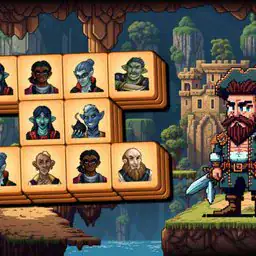
Flip & Match is basically a memory card game dressed up in medieval clothes. You flip over cards to find matching pairs, which is the same thing you did with those little cardboard squares back in the day, but here the art is all knights and dragons and castle towers. The hand-drawn style is actually pretty nice -- it's got this soft, almost storybook look that feels cozy rather than flashy. Each level starts small, like a 4x4 grid, then slowly gets bigger and trickier. There's a chill soundtrack playing in the background, nothing intense, just something to keep you relaxed while you try to remember where the heck that princess card was. I played it for like an hour and didn't even notice time passing. What got me was the castle-building side thing -- every time you finish a level, you earn gold coins, and you can use them to add rooms or decorations to your castle. It's simple, but it gives you a reason to keep going beyond just matching cards. The controls are just clicking on cards, so it's super easy to pick up. If you're someone who likes brain games like Sudoku or those match-three things, or if you just want something low-stress to play while watching TV, this is perfect. It's not trying to be hard or flashy, it's just a solid little puzzle game that respects your time. I'd recommend it if you're into calm, repetitive tasks with a small reward loop.
About Flip & Match
Flip & Match is a memory card game with a medieval theme, but there's more going on than just flipping tiles. You start on a simple 4x4 grid, clicking cards to reveal pictures of knights, dragons, and castles. The core loop is straightforward: click a card to flip it, remember its position, then find its match. Every correct pair disappears with a little jingle, and clearing the board ends the level. That's the basic rhythm, but it shifts as you go.
Difficulty doesn't just come from bigger grids. Around level 10, the game introduces "Cursed Cards" -- these are tiles that shuffle the remaining board when flipped, messing up your memory. There are also "Gold Cards" in later levels that double the coins you earn for that match, which forces you to decide whether to prioritize them or keep your streak going. The level names are silly but fitting, like "Drawbridge Mayhem" or "Dragon's Lair," and each one has a unique tile pattern that changes the layout.
The satisfying moments are when you chain multiple matches from memory -- clicking a card, knowing exactly where its pair is, and clearing two tiles in quick succession. The game rewards speed with a coin multiplier, so there's pressure to go fast, but rushing gets you burned when the Cursed Cards activate. You earn coins based on time and matches, and those coins go into a castle-building side mode. This mode lets you place walls, towers, and banners on a blank plot of land. It's not a full city-builder, just a simple decoration screen where you unlock new structures with enough coins. Some structures, like the "Tower of Flipping," have no gameplay effect, but they look neat.
Later levels throw in a timer -- for example, "Keep the Peace" gives you 90 seconds to clear a 6x6 grid, which is tight. There's also a "Memory Shield" power-up you can buy with coins before a level: it protects you from one Cursed Card activation. That's about all the mechanics. The game doesn't get crazy complex, but the combination of timed runs, curse shuffles, and a simple reward loop keeps you clicking. You're mostly using your brain to track positions and your mouse to click fast. The hand-drawn art is charming, but the real hook is that moment where you flip a card and just know where its match is.
Tips & Tricks
Starting out, I kept focusing on the middle of the grid -- big mistake. The cards in the corners and edges are way easier to track because they stick in your peripheral vision longer. Try memorizing those first. Another thing that tripped me up: the gold coin multiplier resets if you take too many flips, not just if you run out of time. I'd rush and make dumb mistakes. Slow down a bit on the later levels where the grid gets huge; speed comes from accuracy, not panic. The castle-building side quest isn't just cosmetic. Unlocking new card sets actually changes the artwork patterns, which means you can't rely on remembering the same dragon face from before. That threw me off for a few levels. Also, don't ignore the sound. Each card type has a distinct flip sound -- the knights clink, the castles thud. I started closing my eyes for a second after flipping just to listen. It sounds weird but it helped me pair stuff faster. One trick I wish I knew earlier: when you flip two non-matching cards back, the game pauses for a fraction of a second. Use that pause to mentally map their positions instead of immediately clicking another card. Patience pays off. Finally, if you're stuck on a level, try flipping cards in a fixed order -- left to right, row by row -- instead of randomly. It builds a mental grid faster than chaos.










Comments
Please login to leave a comment.