Scan to play on mobile
Golf Pin
How to Play
Game Overview
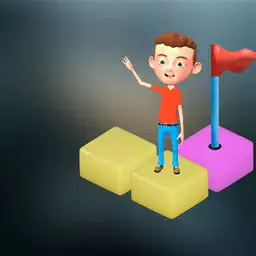
Golf Pin is one of those puzzle games that sounds simple until you actually try it. The visual style is clean and minimal, almost like a digital board game -- bright colors against a plain background, each level a little diorama with pins, bumpers, and a hole waiting at the end. You've got these colored golf balls stuck behind pins, and your job is to knock the pins down in the right order so the balls roll free. But here's the thing: you're not just whacking a ball straight into the hole. Each shot has to hit a specific pin to release the next ball, and the sequence matters a ton. The physics feel solid, not floaty, so when you mess up it's your own fault. What got me was how quickly it goes from "oh that's cute" to "okay I need to actually think now." Levels ramp up fast, adding obstacles like walls that redirect your shot or multiple balls that need to be freed in a precise chain. There are 30 levels, which sounds short, but some of them took me way longer than I'd like to admit. The vibe is chill but focused -- no timer, no pressure, just you and a problem to solve. This would totally hook anyone who likes logic puzzles like Sokoban or those physics toy apps. Also, my kid watched me play and immediately wanted a turn, so it's got that pick-up-and-play appeal too.
About Golf Pin
So Golf Pin is one of those puzzle games that looks simple until you actually try it. You've got these colored golf balls sitting on a course, and there's a hole somewhere. But between you and that hole are these pins--little wooden pegs basically--that you have to hit in the right order. Each pin releases or redirects a ball when struck. The trick is figuring out which pin to hit first, with what angle and power, so the ball bounces off things and eventually lands in the hole.
Your hands are on the mouse or finger on touch. You hold down the left button and drag to set both angle and force--a dotted line shows the trajectory, but it only shows the first bounce or two, so you're guessing a bit for ricochets. Then you release, the ball shoots, and you watch. If you mess up the order, you'll likely hit a pin that blocks something or sends a ball off screen. Then you restart. The early levels, like 'First Tee' or 'Two Balls One Cup,' are gentle introductions--just one or two pins, straightforward lines. But by level 10, they throw in moving pins that slide back and forth on tracks. By level 20, there are bumpers that change color on contact, and you have to match ball colors to them. Level 28 has pins that only activate after a timer runs out, which is annoying.
The satisfying part is when you line up a shot that chains through three pins in one go, releasing two balls that roll perfectly into the hole. The game doesn't have upgrades or currency--just 30 levels. But the difficulty ramps unevenly. Level 14, 'Crossed Wires,' took me like 20 tries because two pins were positioned so that hitting one always sent the ball into a wall. Eventually I figured out you can use a weak shot to just barely tap a pin, which changes the angle without sending the ball flying. That's not explained anywhere. Later levels introduce pins that are destructible--one hit and they break, so you have to plan around losing them. There's also a level with teleport gates, but that's only the last three.
Your brain is doing two things: spatial reasoning for angles and working memory for sequence order. You'll often plan three steps ahead, then realize step two creates a collision you didn't foresee. Restarting is instant, so the loop is: shoot, fail, adjust, shoot again. The game doesn't punish you--no score, no timer--just pure logic. The final level, 'Grand Slam,' has seven pins and four balls, and the solution is a single curved shot that hits two pins sequentially, then ricochets off a wall to hit a third. When you pull it off, it feels like magic. But until then, you're just staring at the screen, moving your mouse back and forth, wondering if you're overthinking it.
Tips & Tricks
I spent way too long on level 14 before realizing something obvious: you can shoot through multiple pins with a single ball if you line it up right. The ball keeps going after hitting one pin, so aim for chains instead of single targets. Early on I kept trying to knock every pin in one go, which just wastes shots. A big mistake I made was ignoring the order pins are connected -- some pins only release after others are hit, so watch the color patterns on the pins themselves. They hint at the sequence. One trick that saved me a lot of frustration: use the edges of the course to bank shots. The walls bounce balls predictably, so you can curve around obstacles without needing perfect angles. For touch controls, I found it helpful to drag your finger slowly -- jerky movements made me overshoot constantly. Also, don't be afraid to restart a level early if your first shot goes wrong; it's faster than trying to salvage a bad start. The force meter is touchy, so lighter taps often work better than hard swings, especially when you need to nudge a ball into position. Finally, those colored balls that look identical? They're not -- each color corresponds to a specific pin order, so track which ball goes where before you start shooting. I kept mixing up blue and green balls and wondering why nothing worked.









Comments
Please login to leave a comment.