Scan to play on mobile
Mahjong Chef
How to Play
Game Overview
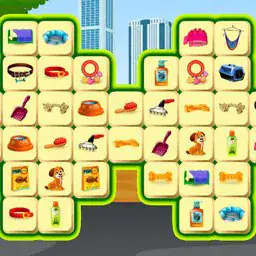
Mahjong Chef is basically Mahjong Solitaire but with a cooking theme slapped on top, which honestly works better than it sounds. You're matching tiles to clear boards, but instead of just any tiles, they're all food-related -- dumplings, chopsticks, teapots, that sort of thing. The visual style is bright and cheerful, kind of like a mobile game you'd play while waiting for your food to arrive. Boards are laid out in these messy stacks, and you've got to figure out which tiles are actually free to click -- only the ones with an open left or right side count. Some tiles are face-down, so you tap them to flip them, which adds a little gamble to the puzzle. Then there are rock tiles that just sit there being annoying until a neighbor gets matched, then they break. It's not fast-paced at all; the vibe is pretty chill, almost meditative once you get into the rhythm. The music is pleasant but forgettable. Who'd get hooked? People who like logic puzzles but don't want the stress of timed modes -- this is pure pattern recognition and planning. You earn coins for clearing stages, which you can spend on stuff like hints or shuffles, but honestly, the base game is fine without them. It's a solid time-waster, nothing groundbreaking, but it scratches that tile-matching itch without demanding much. If you've played one Mahjong Solitaire game, you've played most of them, but the food theme gives it a little personality.
About Mahjong Chef
Mahjong Chef is basically Mahjong Solitaire with a cooking theme, but the food motif is mostly window dressing. You're staring at a pile of tiles stacked in patterns like pyramids or towers, each tile showing a food icon -- dumplings, chopsticks, teapots, that kind of thing. Your goal on each stage is to match and remove every single tile. You tap one to select it, then tap another with the same icon to clear the pair. But here's the catch: only "free" tiles can be picked. A tile is free if its left or right edge isn't pressed against another tile. So you can't just grab anything -- you gotta work from the edges inward, like peeling an onion. Early levels are simple, maybe 36 tiles in a flat grid. The game calls them things like "Stir-Fry Start" or "Dim Sum Duel." But around world two, things get messy. Tiles get stacked in layers, so you have to clear the top ones first. Then face-down tiles show up -- they're just grey squares until you tap them, which wastes a move if you pick wrong. You learn to remember what's underneath by trial and error. Rock tiles are the real jerks. They're indestructible until a tile next to them gets matched, and then they shatter. So you might have a rock blocking your only path to a match, forcing you to plan several moves ahead. The satisfying part is when you clear a whole row or finish a tough stack and the tiles collapse with a little jingle. Coins pop up after each completed stage, which you spend in the shop on items like Undo, Hint, Shuffle, or Magnet. The Magnet is a cheat -- it just auto-matches a pair for you. But using items feels desperate, like you already messed up. Difficulty creeps up mostly through tile count and weird layouts. Some stages have tiles arranged in a circle or a spiral, and you have to mentally rotate the layout to find free edges. There's no timer, so it's a chill puzzle game, but the challenge is in spotting matches before you run out of options. If no moves are left, you have to shuffle, which randomizes everything -- sometimes it helps, sometimes it makes things worse. The loop is: pick a level, scan the board for free pairs, tap carefully, use items if stuck, finish, buy treats for your chef avatar that does nothing. It's simple but the good kind of simple--you can zone out or focus hard depending on the layout.
Tips & Tricks
Don't rush to clear tiles from the middle of the board--it's tempting but often leaves face-down or rock tiles stranded with no way to match them. Start from the edges or where tiles stack high, because those free sides vanish fast once you remove neighbors. That magnet item costs coins but saves you when only two matching tiles remain and they're both trapped--use it as a last resort, not a crutch. I lost a stage once by ignoring a face-down tile early; later it was the only match left, but I couldn't free it because rocks had piled up around it. So reveal those face-down ones first, even if they seem unimportant. Rock tiles breaking when an adjacent tile matches is a hidden clock--plan your moves to break them in sequence, not randomly, or you'll create dead ends. Shuffle is actually better than hint because hint just shows a pair you might not be able to reach; shuffle rearranges everything, which can unlock a stuck board entirely. Undo is for when you mis-tap, not for strategy--save your coins for magnet and shuffle instead. One trick that clicked for me: when a tile is only free on one side, match it before it gets blocked by a later match. The game punishes tunnel vision--look at the whole board, not just the obvious pairs.




















Comments
Please login to leave a comment.