Scan to play on mobile
Merge cubes 2048 3D
How to Play
Game Overview
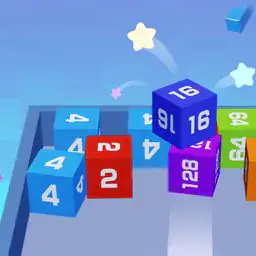
So this game takes the basic 2048 idea and throws it into a 3D space where cubes actually have physics. It''s not just sliding tiles on a flat grid anymore -- you''re dropping numbered cubes onto a platform and watching them tumble around realistically. The visual style is clean and colorful, with each number getting its own bright shade so you can spot matches from across the screen. It feels a lot more chaotic than the original because cubes bounce off each other and stack up unevenly. That physics part makes it trickier than you''d expect -- cubes don''t just lock into place, they roll and settle, and sometimes a smaller cube will bounce off a bigger one and land somewhere annoying. The sound effects are satisfying though, with a nice clunk when cubes merge. You''re trying to combine cubes to make bigger numbers, and hitting the big 2048 cube makes it disappear with a flash. But if any cube touches the red line at the top, you''re done. There''s no timer, so you can take your time planning drops, but the pressure builds as the platform gets crowded. People who liked the original 2048 or games like Tetris with a spatial twist would get hooked. It''s one of those games where you keep telling yourself 'just one more round' because you almost made it. The controls are simple -- hold to aim, release to drop -- but mastering the timing and predicting bounces takes practice.
About Merge cubes 2048 3D
So you've played 2048 before, right? The one where you swipe tiles and hope they combine? This takes that idea and throws it into a 3D space with physics -- which sounds fancy but really means cubes bounce and roll when they land. You start with a few numbered cubes floating above a flat playing field. Your goal? Tap and hold to drag a cube around, then release it to drop. If two cubes with the same number touch, they merge into one bigger number. Build up to 2048 and that cube vanishes -- that's a win. But here's the catch: if any cube rolls off the edge and crosses the red line at the bottom, game over. So you're balancing speed and precision.
At first it's easy -- maybe three or four cubes, low numbers like 2 and 4. You can take your time. But the game throws more cubes at you as you progress. Some levels have names like "Flood" or "Avalanche" -- I think those refer to how fast cubes drop. In later stages, you get cubes with weird shapes or sizes, and they don't stack cleanly. The physics engine means cubes can tip over or slide when you drop them, which is both satisfying and frustrating. That moment when you line up two 64 cubes and they smack together with a little bounce -- yeah, that feels good.
Controls are simple: hold your finger or mouse to grab a cube, drag it where you want, then release to drop. The cube falls with gravity, and it can knock other cubes around. You learn to drop carefully because one bad placement can domino everything off the edge. There's no undo button, so every drop matters.
Difficulty ramps up in two ways: more cubes spawn faster, and the numbers get higher. You start chasing 8, then 16, then 32, and before you know it you're sweating over getting two 256s to touch while six other cubes are wobbling near the line. Combos exist -- if you merge multiple pairs quickly, you get bonus points, but the game never explains that clearly. I figured it out when a "x2 combo!" popped up after I dropped a cube that caused three merges in a row 🔍.
Later on, you might see special cubes like a bomb or a star -- I think they clear nearby cubes or double values, but I'm not sure because the game doesn't teach you. It's more about trial and error. The leaderboard tracks your highest number merged, not just wins, which keeps you coming back. There's no story or upgrades -- just pure, messy cube merging where one slip means starting over. And honestly, that's fine.
Tips & Tricks
- **Tips & Tricks**
Early on, it's tempting to just drop cubes anywhere and hope for the best -- but that'll cost you once the board fills up. A smarter move is to keep your biggest cube in one corner for as long as possible. That way, you're not scrambling to match it while tiny cubes block your path. I learned this the hard way after losing a run with a 512 cube right on the edge.
The physics aren't just for show -- cubes can actually bounce off each other. If you drop a cube at an angle, it might land on a matching number instead of rolling away. Try releasing your cube slightly to the side of where you want it to land, especially when the board gets crowded. This trick saved me more times than I can count.
Don't stress about combos too early. Combos happen naturally when you match several pairs in a row, but chasing them can make you careless. Focus on matching pairs first, and the combos will follow. The bonus points help, but staying alive matters more 🔍.
Watch the ceiling line like a hawk. Once cubes start stacking unevenly, one bad drop can push them over. If you see a column getting too high, prioritize matching those cubes even if it means ignoring a bigger match elsewhere. Losing because of one stray cube is frustrating.
Matching a 2048 cube makes it vanish, which clears space -- but don't expect that to happen fast. The game gets wild around the 1000 mark, with cubes flying everywhere. Stay calm and keep dropping in that corner.
Finally, take breaks. This game punishes tired reflexes -- I've thrown away perfect runs because I dropped carelessly after an hour of play. Fresh eyes help more than grinding ⏱️.











Comments
Please login to leave a comment.