Scan to play on mobile
Pirates Match The Lost Treasure
How to Play
Game Overview
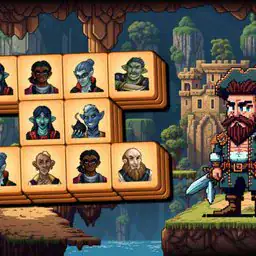
Pirates Match The Lost Treasure is basically a match-3 puzzle game with a pirate theme slapped on top. You're swapping gems on a grid to clear levels, and every so often the game reminds you that there's supposedly a treasure map involved. The visual style is bright and cartoony--lots of blues and golds, with little pirate ships and parrots in the corner of the screen. It looks fine but nothing groundbreaking. The levels start easy enough, just matching three of the same gem to make them disappear, but after a while they throw in obstacles like chains and locked tiles that slow you down. Some levels have a move limit, others have a time limit, and that's where the pressure kicks in. The power-ups are fun--there's a bomb that clears a circle, a cross-blast that goes in four directions, and a color bomb that wipes out all gems of one color. You earn them by matching four or five in a row, so there's a tiny bit of strategy in setting those up. The vibe is casual but not mindless; you'll hit a few levels that force you to think a couple moves ahead. Who'd get hooked? People who like Bejeweled or Candy Crush but want something with a nautical coat of paint. It's not deep or innovative, but it's solid for killing time during a commute or while waiting for a download. The difficulty spikes can be annoying, especially on levels where you need a specific score to pass, but you can always retry or buy extra moves with in-game coins. Overall it's a decent time-waster that knows exactly what it is.
About Pirates Match The Lost Treasure
So here's the thing about Pirates Match The Lost Treasure -- it's a match-3 game, but it's got enough pirate flavor to keep it interesting past the first few worlds. You start off swapping gems on an 8x8 board, matching three or more of the same color to clear them. The goal in most levels is to hit a score target, but later on you'll run into levels with specific objectives like collecting X number of treasure chests or clearing all the chains off the map. The early islands are a breeze, letting you get used to the basics: regular matches, occasional chain reactions when gems fall into place, and the simple satisfaction of watching a row of skull-and-crossbones gems explode.
Around world three, things shift. You start seeing locked tiles that need a match right next to them to break free, and cursed anchors that drop from the top and pin down rows until you match near them. The game throws in mermaid tiles that you have to collect by matching adjacent gems, and ghost ships that appear as obstacles -- they take two matches to sink. This is where you actually have to plan moves instead of just making matches randomly. Your mouse clicks become deliberate: you scan the board, figure out which swap will do the most damage, and sometimes you just have to break a single chain on a locked tile even if it doesn't score points.
Power-ups unlock as you progress. The cannonball clears a whole row, the cutlass slices a column, and the treasure map swaps entire columns or rows. You can combine them too -- a cannonball plus a cutlass creates a huge cross blast that wipes out a big chunk of the board. Those moments are the satisfying payoff after grinding through a tricky level. There's also a parrot helper that appears randomly and swaps two gems for you, which is mostly useless but occasionally saves your skin.
Difficulty ramps up with each island -- the game has 120 levels across eight islands, with names like Skull Cove and Dead Man's Reef. Later levels introduce multi-layered obstacles, like a locked tile on top of a cursed anchor. You'll also face timed challenges in some levels where a kraken tentacle slowly pushes new obstacles onto the board. The upgrade system lets you buy extra moves before a level starts, or boost your starting power-ups with coins you earn from completing levels. It's not deep, but it gives you a reason to replay older levels for more coins.
The core loop is simple: click two adjacent gems to swap them, make matches, clear objectives, move to the next level. But the way the obstacles stack up and the power-ups interact keeps it from feeling repetitive for a while. Some levels I had to retry five times, and that's where the brainwork comes in -- figuring out the optimal sequence of moves.
Tips & Tricks
Early on, I wasted moves trying to clear every single gem. You don't need to do that. Focus on the objectives instead--some levels just want you to collect a certain number of anchor tokens or open chests, and matching around those is way faster. The cannons are your best friend once you figure them out. Aim them diagonally when possible, because they can chain into other matches you didn't even see coming. I kept forgetting the treasure chests that pop up after a big combo. Those sometimes hold extra moves or a key, which can save a run that's about to fail. A mistake that cost me a lot was ignoring the bubble obstacles. You think you can match through them, but they block entire rows until you pop them with a bomb power-up. Save those bombs for bubble-heavy levels--don't waste them on random boards. There's a trick with the parrot power-up that I wish I'd known sooner: it randomly swaps two gems, but if you use it near a cluster of the same color, it often creates a chain explosion. One tip that clicked late for me is that the map has branching paths. If you're stuck on a level, go back and try a different route. Some paths have easier puzzles or better rewards. And always check your move count before using a power-up--if you're at one move left, using a bomb is pointless unless it directly scores the goal. That's how I wasted several runs.













Comments
Please login to leave a comment.