Scan to play on mobile
Planet Explorer Multiplication
How to Play
Game Overview
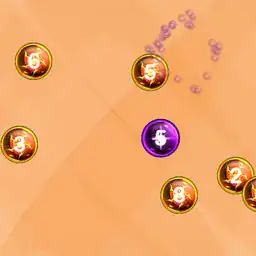
So I''ve been messing around with this game called Planet Explorer Multiplication, and it''s basically a math quiz dressed up in a space suit. You''re this little spaceship hopping between planets, and each planet has these four multiplication problems displayed on its surface. Three of them give the same answer, but one is different--and you have to pick the odd one out. If you''re right, you move to the next planet and collect some gems; if you''re wrong, you just stay put and try again. The visual style is pretty simple, kind of like a cartoon solar system with bright colors and round planets that look like they''re made of candy. It''s not flashy, but it''s clean and easy on the eyes. The vibe is chill--there''s no timer, no pressure, just you and the math. I found myself zoning out while playing it, which is weird because I usually hate math games. But this one feels less like studying and more like a puzzle. The difficulty ramps up as you go, with bigger numbers and trickier expressions, but it never gets frustrating. Who would get hooked? Probably kids who need to practice multiplication without feeling like they''re doing homework, or adults who want a quick brain break that''s not intense. It''s the kind of game you play for five minutes and end up playing for twenty.
About Planet Explorer Multiplication
So you're a little spaceship shooting through space, and every planet you visit wants you to do multiplication. That's basically the whole deal. You land on a planet, and four expressions pop up -- three of them equal the same number, one doesn't. Find the odd one out. Click it. That's your ticket to the next world. Simple start, but it tricks you more than you'd think.
Your hands are just clicking or tapping -- mouse or touch, no fancy combos. But your brain's working the times tables hard. Early planets like Crater 3 or Red Dust keep it easy, numbers like 2s and 5s. You'll breeze through those, grabbing a few gems that float up when you're right. Gems are the score, basically. No real currency, just a number that climbs.
Then around world 4, The Nebula Rings, things get mean. Now the expressions mix bigger numbers -- 7s, 8s, 12s. And the wrong answer isn't always obvious. Sometimes it's 6x7 equals 42 while the others are all 36. You'll pause. Second-guess. That's the good bit.
Later, Asteroid Field throws in a timer. Not on every planet, just on the ones with a little clock icon next to the name. You get ten seconds to pick. Miss it, and you don't lose a life or anything -- there are no lives. You just don't get the gem for that planet, and you move on. No punishment except your own annoyance at blanking on 9x8 💥.
What really got me was The Crystal Caverns. Here, the expressions use the same three numbers but in different orders, like 4x3x2 versus 2x4x3, and one is off by a single factor. You have to actually multiply step by step in your head. Can't just pattern-match. That's where the game separates people who know their tables from people who guess.
Satisfying moment: nailing a hard one with the timer blinking, then watching your gem counter jump. Also, every tenth planet or so, you unlock a Warp Gate -- it's just a different background and a little fanfare, but it feels like progress. The game's loop is tight: land, solve, move. No upgrades, no power-ups. Just multiplication. For some reason, that's enough to keep me going for twenty minutes at a time.
Tips & Tricks
The game throws four expressions at you, but three share a common factor or pattern -- focus on spotting the odd one out quickly by scanning the numbers first. I wasted time multiplying every option in my head, but the trick is to see which answer doesn''t fit the others'' structure. For example, if three involve 7 times something and one is 8 times something, that''s your target. Gems are awarded faster when you answer within a few seconds, so don''t overthink. Early levels trick you with simple differences like 6x4 versus 4x6 -- both equal 24, but check if the game expects you to notice the order matters for uniqueness. I got stuck once because I ignored that and picked wrong. The timer isn''t super strict, but taking too long on a hard planet wastes your run -- skip it if you''re unsure and come back later. Also, the planets aren''t in difficulty order; some middle ones are easier than later ones, so don''t get frustrated if you hit a wall. A mistake that cost me: assuming the answer was always the one with a different product. Sometimes the product is the same, but the factors are arranged differently, and the game wants you to see the pattern. Practice makes you faster at recognizing these patterns -- I started looking for the one expression that doesn''t match the others in terms of multiplier or multiplicand grouping. One more thing: the background music is distracting on hard levels, so I turn it down to focus on the numbers.














Comments
Please login to leave a comment.