Scan to play on mobile
2048 checkers
How to Play
Game Overview
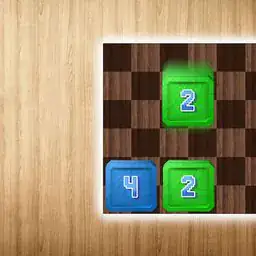
So I checked out this game called 2048 Checkers, and it's basically exactly what it sounds like -- someone mashed up 2048 with checkers and it kind of works. You've got a board with numbered pieces, like those little tiles from 2048 but shaped like checker pieces, and you move them around trying to capture enemy pieces that have the same number. When you do that, your piece's number doubles, just like when you merge tiles in the original game. The visual style is pretty clean -- minimalist with a dark background and bright colored numbers, nothing fancy but it's easy on the eyes. It feels more strategic than regular 2048 because you're not just sliding everything around, you actually have to pick specific moves and think about positioning. There's a coin system too, which lets you do stuff like double a piece's number or remove a stuck piece, and that adds a little meta-layer to it. I could see puzzle fans getting hooked, especially people who liked 2048 but wanted something with a bit more control and strategy. The checkers element makes it feel less random, more like you're actually playing a game instead of just reacting to where numbers land. The leaderboard thing is there too if you're into competing for high scores. It's not revolutionary but it's a fun mix that actually makes sense.
About 2048 checkers
So 2048 Checkers sounds weird on paper, right? A mashup of a sliding number puzzle and a board game. But the actual moment-to-moment play is surprisingly tactile. You start with a standard 8x8 checkers board, but instead of red and black pieces, each checker has a number on it -- 2, 4, 8, that sort of thing. Your basic move is to select one of your numbered pieces and move it diagonally to capture an opponent's piece, but only if that piece shows the exact same number. Land on it and your piece's number doubles. A 2 eats a 2 and becomes a 4. That's the core loop. Flick, capture, double.
What you're actually doing with your hands is tapping a piece, then tapping a valid target square. The game highlights legal moves, which is helpful because the board gets crowded fast. Your brain is constantly scanning for which of your numbers can match an enemy's, while also trying to set up future captures. You can't just grab any piece -- you need a path, and the checkers movement rules mean you can only move forward diagonally unless you're capturing. So positioning matters a lot. Early levels -- the game calls them things like "Checker Meadow" and "Double Alley" -- are pretty gentle. The enemy pieces are mostly 2s and 4s, so you can chain a few captures and ramp up quickly. But then world two hits you with "Reckless Row" and enemies start spawning with 8s and 16s, and they move toward your home row aggressively. That's when you realize you can't just charge in.
Coins drop after every successful capture, and they're your lifeline. You can spend them mid-game to double a checker's number (which is great when you need to match a 32 but only have a 16), remove a piece that's blocking your path, or shuffle the whole board when you're stuck. The shuffle is risky -- it randomizes positions, so you might end up worse off. I've lost a few runs because I panicked and shuffled into a corner. The satisfying moments come when you chain multiple captures in one turn -- you move a 4 into a 4, become an 8, then that 8 is already positioned to take another 8 right next to it. The numbers climb fast, and the screen pulses a little when you hit a milestone like 128 or 512. The end goal is 2048, which takes careful planning and a bit of luck. Late-game levels like "Grand Gambit" throw in special enemy pieces that don't capture -- they just sit there and block your advance until you remove them with coins. It forces you to hoard coins or get creative with movement. The leaderboard tracks your highest checker reached, so there's always pressure to push for that 2048 finish.
Tips & Tricks
Don't just grab any capture you see early on -- I wasted tons of coins that way. The first few moves set your board's flow, so aim for chains where one capture leads right to another same-number piece. If you're stuck, shuffling is usually better than removing a piece; removal costs more and can wreck your setup. I learned the hard way that doubling a checker sounds great but only helps if that number has a match nearby -- otherwise you're just making a lonely big piece. Coins pile up slowly, so save them for mid-game emergencies instead of using them every turn. Late-game, focus on keeping your highest checker mobile; a 1024 stuck in a corner is a nightmare because you need another 1024 to capture it. One trick that clicked for me: watch the opponent's moves if there's a turn-based element -- sometimes you can bait them into setting up a capture for you. Also, don't ignore smaller numbers completely; they're fuel for building toward those big merges. The leaderboard pressure is real, but rushing causes more mistakes than it's worth.
















Comments
Please login to leave a comment.