Scan to play on mobile
Air Force Attack
How to Play
Game Overview
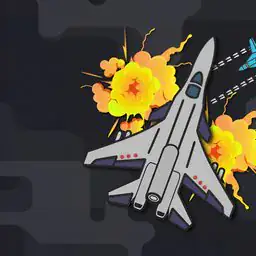
Air Force Attack is one of those shoot-'em-ups where you're a lone plane against waves of enemy fighters, and it's pretty straightforward but also kind of addictive. The setting is this generic war scenario -- you're defending your homeland from some unnamed aggressor, and the visuals are bright and arcade-like, with planes zipping across a blue sky filled with clouds and explosions. It feels like an old-school cabinet game, the kind you'd find in a dusty pizza place, but on your phone. You control your interceptor with mouse or touch, dragging it around the screen to dodge bullets and line up shots, and the machine gun fire is constant -- you just hold down and watch enemies explode into satisfying puffs of smoke. What gets me is the power-ups: they drop from destroyed planes or drift among the clouds, and picking them up upgrades your weapons or unlocks new aircraft. It's not deep -- you're not managing fuel or worrying about realistic physics -- but the rhythm of dodging and shooting hooks you. The missions ramp up fast, throwing more enemies and bigger patterns at you, and that's where the challenge lives. I'd say this is for anyone who likes arcade action games, especially if you have a short attention span and want something to pick up for five minutes. There's no story to follow, no complex strategy -- just you, your plane, and a sky full of targets. The vibe is pure retro, like a love letter to 80s shooters, and it doesn't pretend to be anything else. If you're into that, it's a good time.
About Air Force Attack
Air Force Attack puts you in the cockpit of a fighter jet, and you're flying through a 2D side-scrolling battlefield. Your hands are on the mouse or touching the screen to move your plane around, and the left mouse button fires your machine gun. That's the core loop: dodge incoming fire, shoot down waves of enemy planes, and survive. The first few levels ease you in -- stuff like "Coastal Defense" and "First Contact" where you're facing slow biplanes and basic bombers. You just need to track them with your cursor, hold down fire, and watch them explode. It's satisfying because the hit feedback is instant -- a flash, a puff of smoke, and the enemy spirals down.
But around mission four, "Airspace Violation," things change. Enemy fighters start doing evasive rolls, and a new enemy type appears: the "Stuka Bomber," which flies straight at you but drops a line of bombs that you have to dodge by weaving up or down. Then there's the "Interceptor" class, which is faster than your starting plane and tries to get behind you. Your brain has to switch from just aiming to also managing your position relative to threats from multiple angles. That's when you start relying on bonus items that float in the clouds -- a star icon upgrades your gun to twin cannons, a shield icon gives you a temporary barrier, and a "Wingman" pickup adds an AI buddy that shoots alongside you for about fifteen seconds. Those moments feel great because suddenly you're shredding through what was a tough wave.
The difficulty builds stepwise. Level seven, "Night Raid," cuts your visibility to a narrow cone around your plane, and enemies come from the top and bottom edges more often. You have to listen for engine sounds -- which the game actually does -- to know where they're coming from. Later, in "Final Assault," you fight a boss called "The Dreadnought," a huge flying fortress with multiple turrets. It's not just a damage sponge; it shoots patterns of bullets that force you into tight gaps between streams of fire. You learn to tap your movement instead of holding it to make precise adjustments.
Upgrades unlock as you earn stars from completing missions with high scores. There's a "Cannon Boost" that doubles bullet speed, a "Roll Dodge" that lets you do a quick barrel roll with a double-tap on the direction, and an "Armor Plating" upgrade that gives you one extra hit before dying. The satisfying part is when you chain upgrades -- like the twin cannons combined with the speed boost -- and you can rip through a formation of bombers before they even release their payload. But you still have to watch for the stray bullet from a fighter you missed, and that tension keeps it from ever feeling easy 💥.
Tips & Tricks
The machine gun has a slight spread, so aiming for the lead plane in a formation often gets you hits on the ones behind too. I wasted a lot of ammo trying to pick off stragglers early on. Bonus items are color-coded -- red is a weapon upgrade, blue is a speed boost, and yellow repairs your plane. Grabbing the wrong one at the wrong time can mess up your rhythm, especially during boss fights. There's a sweet spot with the speed boost: it makes dodging easier, but your turning circle gets wider, so you'll overshoot targets if you're not careful. I learned that the hard way in level three. The homing missile power-up is actually a trap on later stages -- it locks onto the nearest enemy, which is often a grunt, while the real threats are behind them. Save it for when you see a cluster of tough fighters. One trick that saved me: you can tap to fire rapidly, but holding the mouse button down fires at a steady rate and lets you focus on movement. It seems minor, but it stops you from accidentally drifting into enemy fire. If you see a green glowing enemy, kill it first -- it drops a rare weapon that chains lightning between targets. The game never explains that, and I missed it until I was stuck on a stage for hours.










Comments
Please login to leave a comment.