Scan to play on mobile
Chain Reaction
How to Play
Game Overview
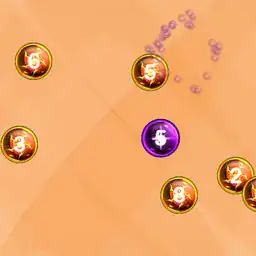
Chain Reaction is this puzzle game I stumbled on that''s way more tense than it looks. The whole thing''s set on a grid that feels like a circuit board--clean lines, neon-ish colors, blocks that slide around with a satisfying snap. You get a row of blocks at the bottom, and you drag them onto empty cells, trying to make numbers touch. When two match, they merge into something bigger, and that can set off a whole domino effect if you''re lucky or smart. The visual style is minimal but punchy, like a math flashcard that got a glow-up. It''s not flashy, but the way combos chain together feels like pulling off a trick shot in pool--each placement matters. The vibe is quiet and focused, no music that distracts, just the sound of tiles clicking and numbers climbing. You''re basically trying to avoid filling the board while chasing bigger and bigger totals. It gets frantic when the field gets crowded and you''re scrambling to set up one last chain before everything locks up. I think anyone who liked 2048 or Threes would get hooked, but also people who enjoy flow-state stuff--like Sudoku but with more immediate feedback. There''s no story, no characters, just you and a grid and the risk of boxing yourself in. It''s oddly meditative until it''s not.
About Chain Reaction
Chain Reaction is a number-merging puzzle where you drop blocks onto a grid, hoping to start a cascade. The core loop is simple: pick a block from a bottom panel, drag it to an empty cell, and watch what happens. Blocks have numbers on them. If you place one next to another block with the same number, they merge -- the new block's value is that number times however many blocks collided. So three '16's become 48, not 32. That multiplication is key. The real fun kicks off when a merge causes a chain -- the new block hits another matching number, and that triggers another merge, and maybe another. You can get a whole chain reaction going from one placement, clearing half the board in seconds. Points pile up fast during those chains, which is satisfying. The grid starts small, maybe 6x6, but later levels introduce bigger fields or obstacles like 'locked' cells that need two merges nearby to unlock. I think they're called 'barriers' in the later stages, like world three or four. Difficulty builds because as you get higher numbers, the board fills up faster, and you have fewer empty spots to make smart moves. The game ends when the grid is full and no merges are possible -- so it's a race to plan ahead. The leaderboard tracks your top score, which is based on merge points, not just the highest number you hit. There's no upgrades or power-ups, which keeps it pure -- just you, the blocks, and the numbers. The satisfying moment is when you set up a placement that wasn't obvious, like dropping a '2' that then goes on a tear through several '4's and '8's, ending with a 256 popping up. You feel clever. The controls are drag-and-drop, but you have to be careful -- once you place a block, it's stuck unless it merges. New blocks appear only after all current ones are placed, so you can't just spam the board. That pacing forces you to think. The game is called Chain Reaction for a reason -- it's all about those explosive combos, not just matching pairs. It's a brain workout, but a fun one.
Tips & Tricks
Don't just place blocks blindly -- think about where the chain reaction will stop. I lost a run because a cascade left a single high-value block stranded in a corner with no matching neighbors, and it sat there useless forever. The merge direction matters more than you'd guess: when you drag a block, it merges in the direction you moved it, so sliding a '4' left into another '4' creates an '8' that keeps moving left. That directional push can chain into other same-number blocks if you line them up right. I once watched a '2' turn into a 128 in one sequence by aiming it along a row of carefully spaced duplicates. Another thing: the bottom panel shows your upcoming blocks, but you can't swap their order -- you're stuck with whatever comes next. So if you see a '16' coming and your field is a mess, it's better to waste a small block in a dead spot than to force a bad placement that fills a critical cell. Points stack fast with long chains, but don't chase big numbers early -- a modest '32' chain that clears space is worth more than a greedy play that clogs the board. I had a game where I ignored a simple '8' merge because I wanted bigger, and the field filled up two moves later. Sometimes the best move is the boring one that buys you room.











Comments
Please login to leave a comment.