Scan to play on mobile
Geometry Rash
How to Play
Game Overview
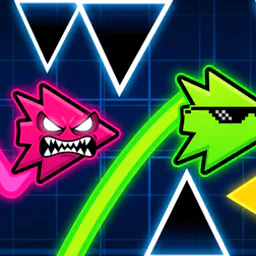
So Geometry Rash is this 2D platformer that's all about timing and rhythm, but not in a chill Guitar Hero way. You're this little geometric shape--a square, maybe a triangle, I forget--zipping through these stark, neon-bright levels that look like a vector graphic came to life and got angry. The setting is just pure abstract space: black backgrounds, glowing lines, spinning hazards, and platforms that appear and disappear. What it actually feels like to play is a frantic, sweaty-palmed dance where every jump has to match the beat of the music. The soundtrack isn't background noise; it's your lifeline. Miss a beat, hit a spike, and you explode into a shower of particles--instant restart, no loading screens, which is good because you'll be restarting a lot. The vibe is less "fun challenge" and more "punishing but fair," like if a metronome had a grudge against you. Who gets hooked on it? People who liked games like Super Meat Boy or The End Is Nigh but want something that syncs more directly with sound. Speedrunners will love it. Also folks who enjoy losing themselves in a flow state where they're just reacting, not thinking. It's not for casual players--there's no hand-holding, no story, just you and the beat and a lot of explosions.
About Geometry Rash
So you hit start and you're in. No menus to fiddle with, just a stark white screen and a beat that kicks in immediately. The first level is called 'First Pulse' and it's basically a straight line with some gaps. You jump with left-click, spacebar, or up arrow--whatever feels right. The circle you control moves to the music, and every time you land on a platform you get this satisfying *thump* that syncs with the track. Miss a jump? You explode into red particles and the music cuts out for a second, then starts fresh. It''s jarring but it makes you want to try again immediately.
Here''s the thing--the game is built on rhythm. Every obstacle is placed on a beat, so you're not just reacting to what you see, you're feeling when to jump. The early levels like 'Second Gear' introduce spikes that slide in time with the bass line. You learn to listen for the crash cymbal that signals a moving wall about to close. Your brain starts working differently--you're tracking the visual patterns while your ears count bars. When you nail a section, it feels like playing an instrument.
About six levels in, you hit 'Glitch Node' and everything changes. The game starts throwing fake platforms at you--they look solid but dissolve on contact. You have to remember which ones are safe, because the music shifts to a distorted beat that makes it harder to tell. Then there's 'Reverb Canyon' where the entire level rotates 90 degrees mid-song, and suddenly up is left and left is down. Your left-click reflex gets scrambled.
Later mechanics include 'Echo Jumps'--you press jump on the beat but the actual jump happens on the next beat, which messes with your timing. There are 'Sync Shards' you collect that add a multiplier to your score, but grabbing one throws off your rhythm because you have to swerve. The game never explains any of this--you just figure it out through explosions.
Difficulty builds unevenly. Level 10 'Overload' is a nightmare of vertical sections where platforms fall away after one use. Level 15 'Null Point' has no music for thirty seconds, just silence and traps--you have to rely on muscle memory. The satisfying moments come when you finally complete a section you've failed twenty times, and the music swells as you land on the final platform. There's no upgrade system, no power-ups--just you, the beat, and the reset button.
Tips & Tricks
Don't rely on your eyes alone. The beat literally tells you when to jump -- I died probably fifty times in the first world before I stopped watching the spikes and started following the bass drop. Each obstacle pattern lines up with a musical phrase, so when the tune shifts, expect a new trap. The double jump feels generous but it's a trap, actually. If you double-tap too early, you'll hang in the air and get clipped by a block that wasn't even a threat yet. Wait until your first jump peaks before pressing again. That cymbal crash? That's your cue. Restarts happen instantly, which is brutal but fair -- you lose no time between attempts, so use that to muscle-memorize sequences in small chunks. Pick one section, repeat it until your fingers know the rhythm, then move to the next. The game punishes hesitation more than speed. I kept pausing to check what was coming, but that broke my flow and I died harder. Just go. Trust the beat. And for the love of god, avoid looking at the score counter in the corner -- it's just there to mess with your focus. One more thing: the background colors aren't random. When the screen goes red, a fast obstacle wave is coming. Blue means a short rest. I didn't notice until world three and it would have saved me hours.




Comments
Please login to leave a comment.