Scan to play on mobile
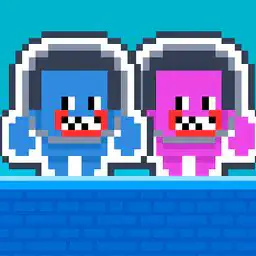
Pixcade 2 Player Escape
How to Play
Game Overview
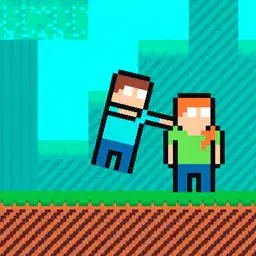
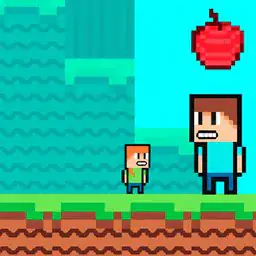
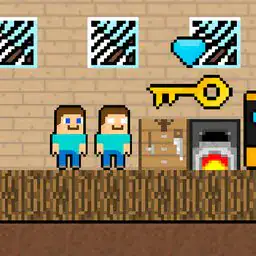
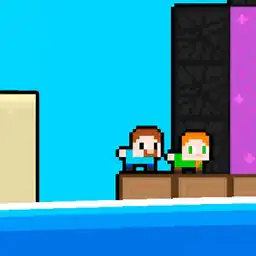
Pixcade 2 Player Escape is one of those games that sounds simple on paper but gets pretty tense once you're actually playing it with someone. You and a friend control twin siblings stuck in a house that feels less like a home and more like a colorful maze designed to keep you separated. The art style is bright and blocky, almost like someone built a dollhouse out of pixel art, which makes the whole thing feel oddly cheerful despite the escape situation. What surprised me is how much the game relies on you actually talking to your partner -- you can see each other's screens but you're each doing different things in different rooms, so coordination matters a lot. The double jump mechanic is nice because it lets you reach higher platforms without too much frustration, but the real challenge is the distance rule: you can't wander too far from your sibling, which forces you to move together even when you'd rather split up. It's not a long game, maybe an hour or two, but every room has these little secrets like hidden coins that are easy to miss if you rush. I'd say it's perfect for two people who already get along well -- siblings, close friends, maybe a couple who wants to test their patience. The vibe is cooperative puzzle solving with a light sense of urgency, but it never feels punishing. Just don't expect a deep story; it's all about the puzzles and the teamwork.
About Pixcade 2 Player Escape
So you and a buddy are stuck in this weird pixel house, playing as twin kids. The name's Pixcade 2 Player Escape. Right off the bat, the game tells you the simple stuff: find two keys, grab all coins, and don't let the distance between players get too big. If you drift apart too far, a red warning flashes and a buzzer sounds, and if you break the tether completely, you're reset to the last checkpoint. That's the core loop -- explore rooms, look for keys and coins, and always keep an eye on your partner's position.
Your hands are on WASD (player 1) and arrow keys (player 2). Double jump is a thing from the start, which helps you reach higher platforms and skip some early pitfalls. The first level is "Living Room Lockdown" and it's pretty chill -- just a few moving platforms and a key sitting on a shelf. The game eases you in. But by the time you hit "Kitchen Crevices," there are spiky ceiling presses that come down in patterns, and you have to time your dashes carefully. Then "Basement Bridge" introduces these rolling barrel enemies that chase whichever player is closer, so you have to split up and coordinate who lures them away.
Later levels like "Rooftop Run" throw in collapsing platforms and wind gusts that push you sideways, making double jumps tricky. There's a mechanic called "Switch Gates" -- colored switches that only one player can press, opening a door for the other. That forces real-time communication. You'll be shouting "Press the blue one, no the left one, NOW!" over Discord or in the same room. The satisfying moments come when you nail a sequence -- one player jumps on a series of timed platforms while the other holds a switch, and you both land on the final ledge simultaneously.
Coins are everywhere, sometimes hidden in breakable blocks or behind fake walls. You don't need every coin to finish a level, but collecting them all unlocks bonus rooms like "The Vault" and "Twin's Challenge," which are harder versions with tighter timers and more traps. There's no upgrade system really -- no power-ups or new abilities -- so the difficulty comes from level design getting meaner, not from your character getting stronger. Enemy types include those rolling barrels, some stationary flame spouts that cycle on and off, and later, floating skulls that chase both players simultaneously. The skulls in "Hall of Mirrors" are annoying because they don't stop until you both stand on pressure plates, which is tough when mirrors confuse your sense of direction.
The game does this thing where it resets your progress if you die too many times in a single level -- not to the start of the game, but back a few checkpoints. That can be frustrating, but it also forces you to actually learn the patterns instead of brute-forcing. The music is a chiptune loop that gets more intense when you're close to the exit. My favorite moment was in "The Attic" -- we had one key, were missing two coins, and the tether warning was blaring because my partner got stuck behind a one-way door. I had to backtrack through a gauntlet of spikes to find the hidden coin behind a painting. That kind of tension is what makes it fun. There's no real story payoff -- you just escape the house and get a "Congratulations" screen -- but the journey is where the game lives.
Tips & Tricks
The double jump isn't just for reaching higher ledges--use it to stall mid-air when timing a moving platform, which saves you from falling into pits repeatedly. One early mistake I kept making was grabbing the key on my side before my partner was ready, because that can lock you into a sequence where one player must backtrack alone. Actually, the coins are often placed to guide you toward hidden switches, not just for score--if you see a coin floating oddly, there's probably a block you can break or a wall that's fake. I learned the hard way that staying close isn't just a rule, it's a mechanical requirement: if you drift too far apart, a death barrier spawns instantly, no warning. For the room with the colored pressure plates, you don't both need to stand on them at the same time--one player can hold a plate down with a crate while the other dashes through. That crate physics feels a bit janky sometimes, so push from the side rather than head-on to avoid it bouncing away. Also, the laser grids in world three have a pattern that repeats every four seconds--count the beats out loud with your partner and it becomes way easier. Communication is everything here, obviously, but specifically call out when you're jumping or moving, because one mistimed double jump can reset a whole puzzle.



Comments
Please login to leave a comment.