Scan to play on mobile
Ludus: Roman checkers
How to Play
Game Overview
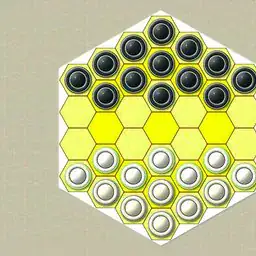
So I finally sat down with Ludus: Roman Checkers, and it's way more brutal than I expected. The whole thing is set in this ancient Roman arena vibe -- think stone textures, red and black pieces that look like carved legion tokens, and a constant feeling like you're about to get stabbed by a gladius. The visual style leans into that, all dark marble and bronze accents, no flashy nonsense. You move your pieces like rooks in chess, straight lines only, no diagonals. Capturing is the nasty part: you have to trap an enemy between two of your pieces, like pincers. That's the core of it -- you're not just jumping over stuff, you're setting up these trap formations. It feels more like a slow, tense chess match than checkers, honestly. The king piece, the Legion's Eagle, is your big target, and if you corner him so he can't move anywhere, he's captured instantly. But if you're down to just your king and can't capture anything, you lose. That rule made me sweat more than once. Who'd get hooked? Anyone who likes abstract strategy games that punish sloppy thinking -- fans of shogi, chess, maybe even Go. The AI is decently aggressive, but playing against a friend locally is where it shines. There's online multiplayer too, and you can spectate matches like a creepy Roman senator, suggesting moves on a spectator board. It's not flashy, but it's got real depth.
About Ludus: Roman checkers
So you sit down with someone across a board that looks like a checkerboard, but with red and dark pieces that could be either checkers or rooks. First thing you notice: these pieces move like rooks in chess. Straight lines only, any number of squares, no diagonals. And you can't jump anything. That's the core loop -- sliding your red or dark army around a board where every move is a straight line, trying to trap the enemy king. The big twist is capturing. You don't jump over pieces to take them. Instead, you sandwich an enemy piece between two of your own on your turn. If you move a piece so that an enemy piece has one of your pieces on one side and another of your pieces on the opposite side -- boom, that enemy piece is captured. You can do this with one move or during a single turn by moving a piece into a position that creates a pincer. This changes everything. You're not just pushing forward; you're setting up these two-piece traps. The king is special. It moves like a rook too, but if it gets blocked so it can't move in any direction, it's captured immediately. That's instant victory for whoever trapped it. The game ends when one player only has their king left, which means the other player wins because there's no way to capture the king with just one piece. That's a bit weird but it makes sense -- you need at least two pieces to pincer anything. The satisfying moments come when you set up a pincer that takes two enemy pieces at once, or when you corner the king by carefully blocking its paths with your pieces. There's no AI in local play, just two humans. The online multiplayer works with matchmaking or friend invites. You can spectate live matches and suggest moves on a spectator board, which is neat for learning. Difficulty builds naturally as players get better at setting up two-move traps and forcing the king into corners. There's no upgrade system or level names -- this is pure Roman checkers, no frills. Just the board, the pieces, and your opponent. The controls are simple: tap a piece, then tap a valid square to move it. Red always moves first. That's it. No power-ups, no special abilities. Just rook movement and pincer captures. The brain work is all about threat assessment -- every move you make leaves a trail of potential pincers for your opponent. You have to think two or three moves ahead about what gaps you're leaving. Sometimes you sacrifice a piece to bait a pincer that opens up a path to their king. The game gets tense fast because one wrong move can lose you your king. The satisfying moment is when you realize you've forced them into a position where any move they make gets their king trapped on your next turn. It's chess but simpler and more direct, with a capture mechanic that rewards positioning over aggression.
Tips & Tricks
Don't treat your king like a protected VIP from the start. In Ludus, the king's rook-like movement makes him a powerful attacker, but leaving him exposed early is asking for trouble -- I lost three games before realizing he's better used to support pincer traps from a safe distance. The pincer mechanic is everything, so learn to bait opponents into moving between two of your pieces. One trick that clicked for me: place a checker one square away from the enemy's line, then use a second piece to slide into position on your next turn, creating an instant capture. Be careful not to clump your checkers, because the enemy can do the same to you -- and once they start pincering your pieces, it's hard to recover. The king's capture condition is sneaky: if he can't move in any direction, he's gone, even if no one took him directly. So avoid boxing him into corners or against the board edge. Online play taught me that spectators can suggest moves, which sounds helpful but sometimes leads to chaos -- ignore random advice unless you trust the source. Finally, when down to your king and a few checkers, remember you can still win by trapping the opponent's king, so don't give up too soon.










Comments
Please login to leave a comment.