Scan to play on mobile
Numbers Match 2448
How to Play
Game Overview
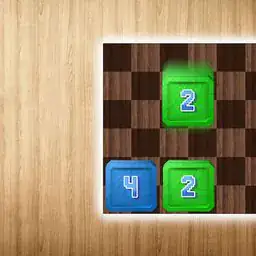
Numbers Match 2448 is basically a more structured take on the 2048 idea, but instead of sliding a whole board around, you''re dragging individual number blocks onto a grid. The whole thing has this clean, minimalist look -- pastel-colored tiles on a dark background, which is easy on the eyes. You start with small numbers like 2 and 4, and you drop them next to matching numbers to merge them into bigger ones. It''s not frantic or anything; more like a slow-burn puzzle where each move matters because the board fills up fast. The vibe is chill but tense in a quiet way -- you''re always scanning for the best spot to place a block, trying to avoid a dead end. What got me hooked is how each level gives you a specific goal, like reach 256 or clear a certain number of tiles, so it''s not just endless merging. The sound effects are subtle, just little clicks and pops when numbers combine. I think anyone who liked Threes or 2048 will dig this, but it also works for people who hate timed games because there''s no clock. The drag-and-drop controls feel responsive on both desktop and mobile, which surprised me -- touch input can be dicey in these games. Some levels make you plan five moves ahead, which is satisfying when it works out. Not a game you''ll binge for hours, but perfect for killing fifteen minutes on a bus.
About Numbers Match 2448
Numbers Match 2448 sounds like a 2048 clone with extra steps, and honestly, that''s fine because the core loop is genuinely satisfying once you get into it. You start each level with a small grid and a handful of number blocks--usually starting at 2 or 4. Your hand moves the mouse or taps the screen to drag a block onto an open cell, and if you place it next to a block with the same number, they merge into the next value: two 4s become an 8, two 8s become a 16, and so on. The goal changes per level--sometimes it''s "Reach 128," other times it''s "Clear 20 blocks in 15 moves." There''s no clock, so your brain is focused on spatial planning: where to put that 2 so you can chain it with another 2 later, or how to keep a column free for an upcoming 8.
The difficulty ramps up around level 10 or so, when the board shrinks to a 4x4 and the game starts throwing in "locked" cells that you can''t place blocks on. Later stages introduce "cold blocks" that only merge if you pair them with a block of the same number within two turns, which forces you to think ahead. Around world 3, you get "disruptors"--enemy blocks that appear randomly and block merges until you match them with a same-number block to destroy them. The satisfying moment comes when you chain three merges in one move--like dropping a 16 next to a 16 that''s already next to a 32, creating a 64 and clearing half the board.
Boosters are a lifesaver. The swap lets you trade two neighboring blocks, which is great when you''ve got a 4 stuck next to an 8. The shuffle rearranges the entire grid, which I only use when the board is completely clogged--maybe once every five levels. The bomb removes a 3x3 area of blocks, but it''s scarce, so you save it for levels with "Clear 10 blocks in 8 moves."
Level names are simple but tell you what''s coming: "First Steps" is tutorial, "Chain Reaction" introduces combos, "Crowded" has a tiny board, and "Freeze Frame" adds the cold block mechanic. There''s no upgrade system--just the boosters you earn by completing bonus objectives like "Merge three 32s in a row." Sometimes you''ll replay a level ten times because one wrong placement floods the board, and you have to start over. That frustration is part of the appeal, though--when you finally nail a perfect chain, it feels earned.
Tips & Tricks
Start by focusing on the center of the board. Blocks placed near the edges are harder to reach later, and merging gets messy when you're cornered. I lost several runs because I ignored this early on. Another thing: don't rush to merge every pair you see. Sometimes leaving two matching blocks separate for a turn lets you line up a triple or quadruple merge, which clears way more space in one go. That's a game-changer once it clicks. The shuffle booster is your friend, but use it only when you have at least two pairs blocked. Wasting it on a single stuck block never worked out for me. For the bomb, aim it at clusters of low numbers that are clogging the board -- saving it for high-value blocks is a mistake because those usually merge fine on their own. A trick that helped me in later levels: count your moves before placing anything. Each level has a hidden rhythm, and if you're one block off from the goal, it's usually because you merged too early, not too late. Also, watch for the board's warning flash -- that's not just decoration. It means one more bad placement ends the level. When that happens, stop and look for a swap option instead of forcing a merge. Finally, practice chaining merges by dropping blocks in the same row -- the cascade effect clears multiple levels at once, which feels great and saves space.















Comments
Please login to leave a comment.