Scan to play on mobile
Scribble World Drawing Puzzle
How to Play
Game Overview
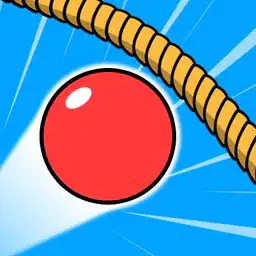
So I picked up Scribble World Drawing Puzzle and it''s exactly what it sounds like -- a little round ball called Scribball needs to reach a door on each level, and you draw stuff to help it get there. The whole game looks like someone''s doodled on a piece of lined paper, which is actually charming. Everything''s drawn with a pencil, kind of sketchy and rough around the edges, and the colors are soft but not washed out. It has this low-key, almost cozy vibe, even when you''re failing over and over. What''s fun is that you''re not just drawing a straight line from point A to point B. The physics are real playful -- Scribball bounces off trampolines, teeters on seesaws, and floats on bubbles. Sometimes you draw a ramp and the ball barely makes it. Other times you need to draw a bridge over a gap or a wall to block a spike. The game doesn''t tell you much, so you learn by messing up. There''s a pencil counter on screen, which limits how many lines you can draw -- that''s the real challenge. You have to be smart with your doodles. The levels start simple but get tricky fast, and some puzzles made me sit there scratching my head. Honestly, this is for anyone who likes creative problem-solving and doesn''t mind a little trial and error. If you enjoyed games like Draw a Line or World of Goo, you''ll probably get hooked. It''s not flashy or loud -- just good, quiet fun.
About Scribble World Drawing Puzzle
Scribble World Drawing Puzzle is one of those games that sounds simple until you're stuck staring at a level called "The Great Divide" for ten minutes. The loop is straightforward: you're this little ball character, Scribball, and you need to reach the star at the end of each stage. What makes it interesting is that you draw the environment yourself. Every line you sketch with your finger or mouse becomes solid--ramps, bridges, walls, whatever you need. But there's a catch: you only have a limited pencil meter, shown as a number at the top. Run out of ink mid-level and you're starting over.
Early levels like "First Steps" and "Gentle Slope" are tutorials in disguise. You just draw a simple line from Scribball to the exit and watch him roll. Then "Bouncy Castle" introduces trampolines that launch Scribball upward. You realize you can draw angled ramps to aim his trajectory. "Seesaw Land" adds balance puzzles--you draw something on one side to tip the other side up. The physics feel appropriately loose, like a toy, not a simulator. Sometimes Scribball clips through your drawing or bounces in a weird direction, which is annoying but also part of the charm.
Around world three, things get mean. "Spike Pit" has spikes everywhere, and you have to draw protective roofs over Scribball as he moves. "Bubble Float" introduces air bubbles that carry Scribball upward--you can pop them by drawing a sharp line through them. Later levels add moving platforms that follow a path, enemies like little red crabs that chase Scribball, and switches that open doors but only when you roll over them. The golden key mechanic appears in every level: you have to collect it before the exit door unlocks. Sometimes the key is hidden behind a wall you need to draw around. Sometimes it's suspended in the air and you need to build a staircase.
What's satisfying is when you solve a level in a way the developers probably didn't intend. Like drawing a single long diagonal line that acts as a slide from the start to the exit, bypassing half the obstacles. The game lets you do that. It's generous. But later levels are designed so tightly that cheesy solutions stop working. "The Maze" forces you to navigate corridors because the walls are too tall to draw over. "Gravity Switch" flips your controls upside down mid-level, which is disorienting at first. The best moments are when you draw something that works perfectly on the first try--a perfectly angled ramp that sends Scribball bouncing through a key and into the exit in one smooth motion. That feels like genuine cleverness.
You'll replay levels to beat your pencil count or find hidden collectible stars. Some levels have multiple paths. The game never explains enemy patterns or switch timings--you learn by failing. And you will fail. A lot. But it's the kind of failure where you immediately know what to try next. So you redraw, adjust the angle, change the thickness of your line, and watch Scribball roll again.
Tips & Tricks
Starting out, I kept drawing straight lines from Scribball to the exit, which almost never works. The physics are bouncy and loose, so your doodle needs to account for momentum. One thing that clicked for me: you don't have to connect the pencil dot directly to Scribball. Drawing a ramp that starts a few spaces away can let him build up speed to roll over gaps. The golden key is a trap sometimes--don't grab it until you've scouted the whole level, because unlocking the door early might block your next path. I lost count of how many times I drew a bridge that was too short, leaving Scribball hanging mid-air. Make your lines extend past where you think they need to go, especially over pits. The trampolines are finicky: drawing a line too close to them can cancel the bounce, so leave a small gap. That saw you're balancing on? You can draw a small wedge under one side to tilt it, which helped me cross a platform I thought was impossible. Pencil count matters more than you'd guess. Early on I wasted dots on fancy decorations, but each one counts toward your limit. If you're stuck, rewind and see if a simpler sketch works--sometimes a straight line with a tiny curve at the end beats a complicated spiral. Also, bubbles float upward forever unless you pop them, so you can ride one across a gap if you time your doodle to catch it mid-air. That trick saved me on level 23.







Comments
Please login to leave a comment.