Scan to play on mobile
Team Loyalty
How to Play
Game Overview
Team Loyalty is one of those games where you start with a single little dude and then things get chaotic fast. The whole gimmick is you march this line of characters through gates that either add more guys or change their color, which apparently means something for team loyalty. The setting is kind of minimal -- plain backgrounds, flat colored characters, no real story to speak of. It feels like an arcade time-waster, something you'd play waiting for a bus or standing in line. The vibe is pure mobile game energy, not trying to be anything fancy. You swipe left or right with your mouse or finger, and your entire column moves as one block. There's no real skill besides timing when to pass through gates, because bumping into enemies or obstacles shrinks your group. Honestly, the game gets more frantic as your army grows, and you start losing guys left and right. Who would get hooked? People who like those "merge" or "grow your number" games but want something simpler. It's not deep, but the loop of building a bigger team then watching it get wrecked is oddly satisfying. The visuals are clean and bright, nothing special, but they work for what it is. If you've played any endless runner or swarm-based game, you'll know exactly what to expect here. It's not revolutionary, but it does its one thing well enough to keep you tapping for a few minutes.
About Team Loyalty
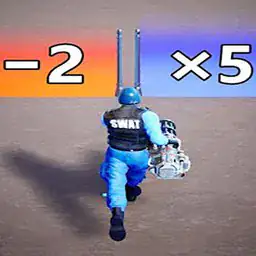
Team Loyalty is that kind of arcade game where you start small and just... grow. You begin with a single little guy following a path, and the whole point is to walk through these gates that add more followers to your squad. Each gate either doubles your numbers, adds a fixed amount, or sometimes even splits your group -- which is annoying until you realize it's part of the strategy. The core loop is simple: guide your blob of characters left or right by swiping (mouse on desktop, finger on mobile) to avoid obstacles and steer toward the right gates. You're trying to reach the end of each level with as many units as possible, because bigger numbers mean you can smash through barriers and defeat enemy groups that block the way.
Difficulty ramps up fast. Early levels like "Green Pastures" just throw a few red barriers and easy splits, but by "Iron Gates" you've got moving walls that crush your units if you're not paying attention. Later, enemies show up -- these grey squads that charge at you, and you need a larger force to push them back. There's also a mechanic called "Loyalty Check" where gates sometimes turn hostile and drain your numbers if you pass through them wrong. That keeps you on edge because one wrong swipe and your army gets halved.
The satisfying moments are when you hit a perfect chain of double gates and your blob suddenly swells from ten to forty in seconds. Watching that mass of characters bulldoze through a wall of spikes feels great. There's an upgrade system between levels where you can spend coins earned from finishing stages to boost starting unit count or reduce the penalty from losses. Some levels have branching paths, so you choose which gate sequence to follow -- that's where brain work comes in, figuring out if a short-term gain is worth a long-term risk.
You're constantly swiping, dodging, planning two steps ahead. It's not just about getting big -- it's about not getting too greedy. Sometimes the best move is to take a smaller gate to avoid a trap later. The game doesn't explain all this upfront, so you learn by failing. That feels more natural than a tutorial anyway. By world three, there are boss-like enemy waves that require you to have a specific minimum count to survive, so you start memorizing gate patterns from earlier levels. There's a nice rhythm to it once you get past the early confusion.
What I like is how the controls match the action -- swiping left or right feels immediate, no lag, no fuss. The music shifts when your squad gets big, which cues you in without looking. Not everything is perfect though -- some later levels feel unfair with tight corridors and instant-death traps, but that's part of the challenge. You'll restart a level ten times, then nail it once and feel like a genius.
Tips & Tricks
I wish I'd known earlier that the gates aren't just free growth -- each one has a hidden timer before it closes. If you're slow, you'll lose that potential army boost, so keep your main unit moving fast. The swarm of little followers can get stuck on edges sometimes; a quick swipe in the opposite direction unsticks them better than trying to nudge forward. For some reason, the first few gates in each level give bigger boosts than later ones, so don't waste time collecting stragglers early -- push through gates aggressively. A mistake that cost me repeatedly was trying to dodge enemies by swerving; instead, plowing through them with a big group actually works better because your numbers absorb the hits. Late-game levels introduce gates that shrink your army if you pass through them wrong -- look for color cues on the gate frame to know which ones are traps. Mobile players, be warned: the swipe sensitivity feels off on small screens, so use shorter, quicker flicks on your finger rather than long drags. One trick that clicked for me: if your army gets too big, it becomes sluggish and hard to control, so sometimes it's smart to skip growth gates and pick paths that thin out your numbers for tight spaces. Don't obsess over a perfect run; you can retry levels fast, and the game doesn't punish you for restarting. Focus on the gate order and your momentum -- that's what actually wins.





















Comments
Please login to leave a comment.