Scan to play on mobile
Stair Run
How to Play
Game Overview
Stair Run is this weirdly hypnotic game where you're just climbing an endless staircase. The whole thing looks super minimal -- like, white steps against a plain background, almost like a sketch. There's no story here, no characters, just you and this tower of stairs going up forever. It feels less like a race and more like a rhythm game mixed with a platformer. You tap to jump, but the timing has to be spot-on because the stairs shift around. Some have springboards that bounce you higher, which is satisfying but also throws off your rhythm. Then there are gaps you have to clear, and obstacles that pop up from nowhere that'll knock you down a few steps if you hit them. The higher you go, the faster everything gets. It gets tense. I found myself clenching my jaw after a while. The vibe is almost meditative at first, then chaotic -- like the game is testing how long you can keep your cool. Who'd get hooked? People who like chasing high scores and don't need fancy graphics. It's one of those 'just one more try' games. You screw up early and immediately want to restart because you know you can do better. My buddy who never plays mobile games got sucked into it for an hour. It's simple but punishing, and that's what makes it stick.
About Stair Run
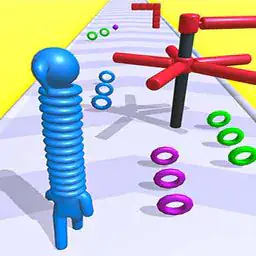
So you've got Stair Run, and it's this 3D arcade game where you just keep climbing stairs forever. The whole thing is pretty minimal -- clean visuals, no story to worry about, just you and this endless staircase that shifts as you go up. Your objective is dead simple: get as high as you can without falling off or hitting something that knocks you back down. That's it. But the game makes it tricky in ways you don't expect at first.
The early levels -- they call them things like "Gentle Slope" and "First Steps" -- are basically tutorials. You're running up these wide, stable stairs with a few holes here and there. You tap or click to jump, and the timing feels forgiving. Springboards show up early, colored bright yellow, and they bounce you up a few extra steps if you land on them right. Missing them just means you keep climbing normally, no big deal. But around world two, "Wobbly Path" and "Shifting Treads" introduce moving stairs that slide sideways or tilt slightly. That's when your brain has to start paying attention. You're not just running forward anymore -- you're reading the pattern of where the next step will be, adjusting your jump height by how long you hold the button.
By the time you hit "Cracked Summit" or "Chaos Ascent" around level 15, the game throws in red barriers that pop up randomly, gaps that are three steps wide (which means a perfect springboard bounce or nothing), and these blue enemies called "Stumble Bots" that roll down the stairs toward you. You can jump over them or time a slide -- there's a slide mechanic unlocked after world four -- to let them pass under you. The satisfying moments come when you chain a springboard into a slide under a barrier, then land on a moving step right before a gap. It feels like a rhythm game where you're the dancer.
Difficulty ramps up fast. Later worlds like "Vertical Rush" and "Endless Pitch" make the stairs narrower and the obstacles faster. You'll see green speed pads that boost your run for a few seconds, but they also make your jumps harder to control, so you have to decide if the risk is worth it. There's no upgrade system -- you just get better at reading the patterns. The game tracks your highest step count and gives you a rank from D to S based on consistency. The real loop is about chasing that next personal best, one more run to see if you can clear that section that tripped you up last time. It's punishing but in a way that makes you want to try again immediately.
Tips & Tricks
The springboards aren't all the same -- some bounce higher than others, and you'll notice a visual shimmer on the big ones. Missing that cue cost me plenty of falls early on. Obstacles come in patterns: after a series of moving ones, there's usually a static gap right after, so don't relax too fast. I started rushing every jump, which is a mistake -- sometimes waiting a half-second lets a bad platform cycle back into place. The camera angle can trick you; it looks like you're lined up but you're actually slightly off, so use the staircase edges as a reference, not the center. One trick that clicked: if you're about to hit an obstacle, jump early instead of late -- the collision box is bigger than it looks, and early jumps clear it more often. Losing momentum is worse than taking a slower, safe path -- a single fall resets your rhythm completely, and getting back up is harder than staying steady. Don't mash the jump button; each press locks you into an arc, and double-tapping in panic just wastes your only air control. The last tip is weird but works: blink less during fast sections -- keeping your eyes locked on the next two platforms ahead helps your brain react faster than looking at your character. It's not a glitch, just how your focus works. Finally, if you hit a springboard perfectly, the sound pitch changes -- listen for it, because the visual feedback is subtle and easy to miss when everything speeds up.














Comments
Please login to leave a comment.