Scan to play on mobile
Bouncy Ball Challenge
How to Play
Game Overview
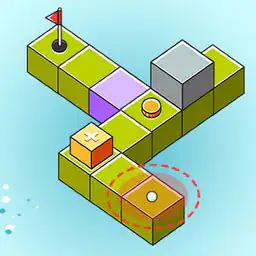
So I''ve been playing this thing called Bouncy Ball Challenge, and it''s basically a puzzle platformer where you''re a ball trying to get to a teleporter. The twist is every block you touch starts disappearing after one or two bounces, which makes you think ahead instead of just hopping around. The setting is this floating world of platforms against a dark sky, with bright neon colors on the blocks--kinda gives it an arcade feel like something from a 90s game cabinet. Visuals are simple but clean, nothing fancy, just blocks and your ball. Playing it feels tense because you''re always a second away from falling into the void if you misjudge a bounce. You click to jump, and the physics are bouncy but responsive, so you need to time your landings. It''s not a chill game--more like a quick burst of stress that keeps you retrying levels. Who''d get hooked? People who like short, punishing puzzles where every move matters, like old flash games or those mobile platformers that don''t hold your hand. It''s free and no download, so easy to waste time on. I''d say it''s good for a coffee break, but don''t expect a deep experience--just pure bounce-or-die action.
About Bouncy Ball Challenge
So Bouncy Ball Challenge is one of those games where the premise sounds simple but it gets real mean real fast. You're a little ball on a series of floating blocks, and your only goal is to reach the teleporter at the end of each level. The teleporter looks like a glowing blue portal with a spinning ring around it--pretty obvious. Your mouse controls everything: you click and drag to aim, then release to launch your ball in a straight line. There's no jump button, no double jump, none of that. Just one shot, and then you watch it bounce around physics-style until it either hits the teleporter or falls into the void, which happens a lot.
The core loop is: aim, launch, watch, curse, retry. Each block you land on disappears after a certain number of bounces. Some break instantly on contact, others flash white the first time and vanish on the second bounce, and later on you get these dark grey blocks that need three bounces before crumbling. So you're constantly thinking about your path not just for right now but two or three bounces ahead. The satisfying moment is when you bank a shot off a crumbling block to hit a teleporter on the other side of the map--feels like you're playing pool with gravity.
Difficulty ramps up around level 8, which is called "The Gantlet." That one introduces moving blocks that slide back and forth, so your timing has to be perfect. By level 12, "Spiral Descent," there are rotating arms that knock you off if they touch you. Later mechanics include wind zones that push your ball mid-flight, which completely changes how you aim--you have to lead your shots into the draft. There's also a level called "Ghost Blocks" where some platforms are invisible until you land on them, so you're basically guessing half the time.
The game has a star rating system on each level based on how few launches you use. Getting three stars means you did it in the minimum possible shots, which is usually 3 to 5 launches. That's where the real challenge lives--trying to chain multiple bounces in a single shot to clear several blocks at once. There's no upgrade system or power-ups, just pure level-after-level gauntlet. The game saves your best score per level automatically in your browser's local storage. Some levels drove me up the wall for 20 minutes straight, like level 19 "The Gauntlet Returns" which has both moving blocks and wind. But when you finally nail that perfect shot sequence, it's genuinely satisfying in a way that a lot of flashier games aren't.
Tips & Tricks
You'll want to get a feel for how long each block type lasts. The ones that vanish after one bounce are obvious, but those two-bounce platforms? They crack on first contact, so you can sometimes use them twice if you're quick. I lost count of how many times I rushed onto a cracked block thinking it was solid. Don't be me. The teleporter's position is a hint, not a guarantee -- sometimes the obvious path is a trap, and the real route involves bouncing off a wall first. That's a thing: walls can redirect your ball if you hit them at an angle, which is actually useful for reaching weirdly placed platforms. Mouse control is twitchy, so small movements work better than big sweeps. I kept overshooting until I started tapping instead of dragging. One mistake that cost me a run: assuming every level has a safe spot. Some are designed so you have to keep moving -- standing still on a single-bounce block is just asking for a fall. When you're stuck, watch the block patterns for a few seconds. There's usually a rhythm you can follow, like a beat you have to match. My best tip? Patience beats speed every time. The timer isn't running, so take a breath before each jump.







Comments
Please login to leave a comment.