Scan to play on mobile
Head Jump
How to Play
Game Overview
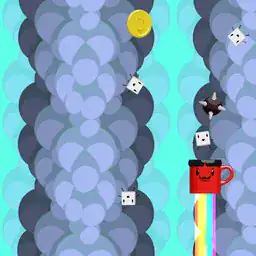
Head Jump is one of those arcade games where you just keep dying and somehow that''s fine. Your character runs forward automatically through these neon-colored mazes that shift and change as you go. The visual style is like if a rave and a 90s screensaver had a baby--lots of bright pinks, blues, and purples that flash around while you''re trying to focus on not slamming into spikes or bottomless pits. The music is actually pretty good, this upbeat synth soundtrack that makes you feel like you''re in a frantic chase scene from a movie. Controls are simple: jump, slide, and climb. But the game loves to trick you. Obstacles pop up with barely any warning, and the camera lurches around awkwardly sometimes, which can throw off your timing. It feels frantic and chaotic in a way that''s frustrating but also keeps you hitting retry. The difficulty ramps up fast--early levels are manageable, but later ones feel like they''re designed by someone with a grudge. Who would get hooked? Probably anyone into tough speed-run games like Super Meat Boy or The End Is Nigh, but without the tight precision those games have. The movement can feel a bit floaty compared to those classics. Still, it''s a fun brain-off game for short bursts. Not something I''d play for hours, but perfect for killing fifteen minutes on a bus or between classes.
About Head Jump
So Head Jump drops you in and your character just starts running to the right automatically. No break, no slow start -- you're moving from frame one. Your job is to tap or hold to jump, swipe down to slide, and hit walls to climb them when you see ledges. Early levels like "Green Hills" or "Crystal Cave" ease you in with wide gaps and obvious spikes, but the game doesn't waste time before getting mean. By world two you're dealing with saw blades that spin on timers, collapsing platforms that vanish after you touch them, and those stupid little arrow traps that shoot from walls without warning.
Your main objective is just to survive each level and reach the finish gate. Levels are short -- usually 30 to 60 seconds -- but every run feels tense because one mistake sends you back to the start. There's no health bar, no second chances. You hit a spike or a crusher or fall in a pit and you're done. The satisfaction comes from nailing a tricky sequence of jumps and slides without ever slowing down. When you chain a wall climb into a slide under a low barrier into a double jump over a pit, it feels good. Really good.
Difficulty builds in two ways: new enemies and tighter timing. Later levels throw in bouncy mushrooms that launch you unpredictably, buzzsaws that move back and forth in patterns you have to memorize, and ice blocks that make you slide further than you expect. There's also a mechanic called "Momentum Zones" -- sections where the ground glows blue and you run faster, making jumps harder to time. By world four ("The Core"), levels have multiple paths and secret collectible gems that unlock cosmetic skins. The skins are just visual -- a robot suit, a wizard hat -- but they're fun to grab.
Upgrade system is pretty basic: you earn coins from completing levels and can buy things like slow-motion goggles (lets you slow time for a second once per run) or a shield that blocks one hit. Both cost a lot and you'll probably only afford one per play session unless you grind. There's also a daily challenge mode that randomizes traps and gives bonus coins. The music shifts between levels -- upbeat synth for forest stages, darker electronic for factory ones -- and it actually helps you keep rhythm on tougher sections.
What's annoying is how some obstacles feel cheap on first encounter. Like those floor panels that flip to spikes a second after you step on them -- you can't react on blind playthrough. You just have to die and remember. But that repetition is part of the loop. You learn, you adapt, you shave seconds off your time. No two runs feel exactly the same because trap timers have slight randomness. The game doesn't hold your hand and that's fine.
Tips & Tricks
I spent way too many runs getting wrecked by the same spike pit before I realized you can actually slide under some obstacles that look like they need a jump. The game doesn't tell you this, but if you hold down the slide just before a low-hanging barrier, you'll zip right under it and save a fraction of a second. That micro-saving adds up fast when you're chasing a perfect run.
Another thing that clicked for me: the music isn't just background noise. The beat actually syncs with the rhythm of the traps in certain levels. Listen for a bass drop or a change in tempo -- that's usually your cue that a tricky section is coming. I started timing my jumps to the music and suddenly I wasn't getting caught off guard as often.
Climbing is slower than running, so avoid it unless you absolutely have to. Early on I kept climbing walls I could have just jumped over, and that cost me precious time. Also, watch your head -- there are hidden ceiling spikes that only appear when you're about to bonk into them. I died three times to the same invisible spike before I learned to duck after every tall jump.
Don't mash the jump button. That was my biggest mistake. If you spam it, the game sometimes registers a double jump that launches you into a trap you were trying to avoid. Tap once, wait a beat, then react. Precision beats speed here.
Finally, memorize the first few obstacles of each level. The game is consistent about the layout, so once you know the opening pattern, you can save your focus for the later chaos. I started watching the background for visual cues -- certain wall colors or patterns repeat before a slide or jump section. It's subtle, but once you see it, the levels feel less random.













Comments
Please login to leave a comment.