Scan to play on mobile
Halloween Link
How to Play
Game Overview
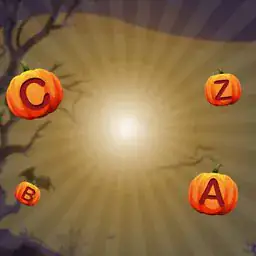
Halloween Link is basically a matching game where you're pairing up spooky icons on a grid, but the twist is you have to connect them with a path that can only turn twice. I played this around Halloween last year and got way more into it than I expected. The visuals are pretty simple -- think cartoony pumpkins, bats, ghosts, and candy corn, all on a dark purple board with a few flickering candle decorations. It's not flashy or anything, but the vibe is cozy in a mildly eerie way. The game has 24 levels that start easy and then get sneaky hard, especially when the board fills up with tiles that block your paths. What gets me is the spatial puzzle aspect -- you're staring at the grid, mentally tracing lines, and when you finally spot a connection that works, it's satisfying in a small way. The controls are just clicking or tapping two matching tiles, so it's dead simple on the surface. But the challenge comes from planning ahead because if you mismanage your pairings, you can trap yourself with no valid moves left. I'd say this hooks people who like puzzle games that are more about careful observation than speed -- think along the lines of Mahjong or those old PC matching games. It's not frantic at all, more of a slow-burn brain teaser that fits a lazy afternoon. Honestly, the Halloween theme is just window dressing, but it works well enough for the season.
About Halloween Link
Halloween Link is a matching puzzle game where you click or tap pairs of identical spooky icons to clear them from a board. The catch is that the two tiles must be connectable by a path that can bend at most twice, and the path can't go through other tiles. So you're scanning the grid with your eyes, planning a route in your head, then clicking the first tile, then the second. If the game finds a valid three-segment line, both tiles vanish with a little pop. If not, nothing happens and you try again. The core loop is simple: find a pair, check the path, clear them, repeat until the board is empty. Each level has a time limit shown as a shrinking pumpkin bar at the top, but it's generous--you're more likely to lose by painting yourself into a corner where no pairs can connect. That's the real tension. Early levels like "Pumpkin Patch" and "Bat Wings" give you lots of open space and obvious matches. By level 5, "Graveyard Shift," the grid gets denser and tiles start overlapping visually--some are half-hidden behind tombstones, which is annoying but you get used to it. Around level 9, "Haunted Mansion," the game introduces frozen tiles that can't be selected until you clear adjacent ones first--they look like little ice cubes with skulls inside. Later on, level 14 "Witch's Brew" adds moving tiles that shuffle positions every few seconds, which forces you to remember where things were and act fast. The satisfying moments come when you clear a tough board with one last pair, especially if you had only two possible matches left and both were buried behind others. There's no upgrade system or power-ups--it's pure puzzle solving. The only helper is a hint button that highlights one valid pair, but using it costs you ten seconds from the timer. Levels are numbered 1 through 24, each with its own name like "Zombie Walk" or "Frankenstein's Lab." After finishing all 24, you unlock a bonus mode called "Endless Scream" where the board resets with new tiles after each clear, and the timer gets shorter each round. But even in the main campaign, the difficulty ramps up unevenly--some early levels are harder than later ones because of tile placement, not just quantity. Your hands are doing simple clicks or taps, but your brain is constantly tracing imaginary lines across the grid, double-checking turns. It's not flashy, but it works. The game saves your progress automatically after each level, so you can stop anytime. If you fail a level, you can retry immediately without penalty. There's no story or cutscenes, just the board and the timer and the little ghost that floats across the screen between levels.
Tips & Tricks
Start by scanning the whole board for the easiest pairs--those sitting right next to each other with no obstacles. It''s tempting to grab the first match you see, but clearing the outer edges first opens up the middle. If you get stuck, look for pairs that share a clear path along the same row or column, since those only need one turn. A big mistake I made early on was ignoring the two-turn limit--you can''t just zigzag wildly. The path must be a straight line, then a turn, then another straight line, and only one more turn. So plan your route before clicking. When the board gets crowded, focus on blocks near the corners or edges because they often have more space for your line to bend around. I lost a few runs by wasting time on a tricky pair in the center when an easy one was hiding behind it. Also, the game doesn''t penalize you for taking long, so pause and trace possible connections with your finger or mouse. One trick that clicked for me: if you can''t find a match, rotate your view mentally--sometimes a pair is separated by only one block you overlooked. Keep an eye on the timer if there is one, but don''t rush too much or you''ll miss obvious links. Finally, don''t force a match if the path needs more than two turns--skip it and come back later.







Comments
Please login to leave a comment.