Scan to play on mobile
Emerland Solitaire
How to Play
Game Overview
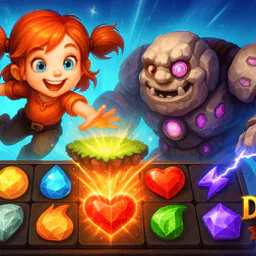
Emerland Solitaire is basically a solitaire card game with a fantasy paint job. You know those classic card-stacking puzzles where you match numbers and clear the table? It''s that, but you''ve got a cheesy story about mages fighting over a magic Card Source, and your helpers are a Knight, an Elf Archer, and a Sorceress. The visual style is bright and cartoonish, like a budget mobile game from 2010 -- lots of shiny gems and green forests. Playing it feels weirdly chill at first, then gets frustrating when the random card draws screw you over. You click cards to move them between piles, trying to free up the ones underneath. There''s no timer in the early levels, so you can take your time, which is nice. But later levels throw in stuff like limited moves or locked cards, and that''s where the difficulty spikes. The vibe is pure casual: it''s the kind of game you''d play on a laptop while watching TV. Who would get hooked? People who dig solitaire variants but want a little more flavor than Windows'' free version. If you hate randomness in puzzle games, skip it -- luck plays a big role. The card combinations and level objectives keep things somewhat fresh, even if the fantasy story is just window dressing.
About Emerland Solitaire
So Emerland Solitaire is one of those solitaire games with a fantasy story slapped on top, but it actually works pretty well. The core loop is you're clearing boards of cards by matching pairs that add up to 13. That's the basic rule -- you click one card, then another, and if their values total 13, they disappear. Kings are 13, so they just vanish on their own when you click them. Queens are 12, Jacks are 11, and the rest are their face values. Aces count as 1.
The first few worlds, like the Emerald Forest or Sunken Temple, are pretty gentle. You've got maybe two or three piles of cards, some face-down ones you need to uncover, and you're just clicking away. But around world three or four, things start getting mean. The game throws in locked cards that need a key item to unlock, which you get from clearing certain combos. Then there are cursed cards that flip back to face-down if you don't pair them fast enough. That's when your brain has to start planning ahead instead of just clicking.
Your hands are mainly on the left mouse button, dragging cards around sometimes to reorganize piles, which is useful. You can also use the undo button, but it costs you points, so you don't want to lean on it. The deck at the bottom gives you extra cards when you're stuck, but you can only go through it once or twice depending on the level.
The satisfying moments come when you clear a whole board in one smooth sequence, especially on those later levels where every pile has three or four cards stacked. There's a world called the Crystal Caverns that has these mirror cards that reflect your moves back at you -- I still don't fully understand how they work, but they make things tense. You unlock new assistants like a fairy that gives you hints or a dwarf that breaks locks, but honestly the fairy is useless half the time.
Difficulty builds in stages -- early worlds are tutorials basically, middle worlds introduce special cards, and late worlds throw combinations of mechanics at you. The Dark Tower levels near the end are brutal, with every card having some modifier. You'll replay some levels five or six times before the layout clicks. There's no real penalty for losing except you have to restart the level, which is fine. The reward system is mostly cosmetic -- new card backs and borders.
What I actually do with my brain is count cards in my head, trying to remember what's under face-down piles based on what I've already paired. It's not deep strategy, but it's enough to feel smart when you pull off a long chain.
Tips & Tricks
Early on, I kept hoarding the power-up that reveals all remaining cards on the board, thinking I'd need it for a tougher level. That was a mistake -- use it whenever the layout gets cluttered, because clearing a tableau quickly gives you a bigger score bonus. The Knight's shield ability isn't just for show; it blocks one shuffling penalty when you're stuck, so save it for moments where you've only got one or two moves left. Stacking those gem multipliers is where the real points come from. I didn't realize until world three that matching three of the same color in a row triggers a chain reaction that wipes out multiple cards at once -- aim for that rather than random pairs. The Archeress's arrow lets you target a specific card from the waste pile, which saved me more than once when I needed that one stubborn card to unlock a cascade. Also, don't ignore the bonus levels that pop up between worlds; they hand out permanent upgrades like extra draw cards and bigger hand limits. Those are worth grinding for because later levels get brutal with time limits. Boss fights shift the rules -- you're racing against a timer instead of clearing boards, so prioritize speed over perfect matches. One late-game trick that clicked for me: when the Dark Master throws down curse cards that lock rows, the Sorceress can cleanse them instantly if you've built up her mana meter. That's something the game never explains well.






















Comments
Please login to leave a comment.