Scan to play on mobile
Ugolki - halma
How to Play
Game Overview
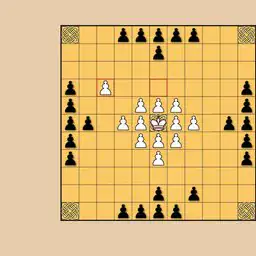
Ugolki is basically halma with a different name, and it's one of those abstract board games that looks simple but gets really tense. The setup is clean--just a board with colored checkers, your starting corner opposite your opponent's. You're trying to get all your pieces across into their territory, and they're doing the same to you. The visual style is minimal, almost like old-school checkers or chess, with solid colors and a grid that doesn't distract. What makes it feel different is the jumping mechanic: you can chain jumps over any pieces, yours or theirs, as long as there's an empty space behind them. That means you can suddenly zip across half the board in one turn if you set it up right, but it also means one mistake leaves you stuck. The vibe is quiet and focused--there's no flashy animations, just you staring at the board figuring out routes. Playing against AI is chill, good for learning, but online multiplayer is where it gets sharp because real people will bait you into bad jumps. The diagonal movement option changes everything--it opens up angles and makes the game faster. I think it hooks people who like chess or checkers but want something less formal, more about rapid positioning than long-term strategy. It's also great for two players sitting across from each other, passing the phone back and forth, because turns are quick and you can trash talk between moves. The 80-turn limit keeps games from dragging, which I appreciate.
About Ugolki - halma
Ugolki--halma is basically checkers' weirder, smarter cousin. You start with a bunch of checkers lined up in your corner, and you need to get them all across the board to the opposite corner. Sounds simple, but the whole thing turns into a traffic jam real fast.
The core loop is: pick a checker, move it one space up, down, left, or right. Or, if you've got a chain of checkers lined up, you can jump over them like in checkers--but here you can jump your own pieces too, and you can keep jumping as long as there's a clear landing spot after each hop. That's the big brain moment: you can string together these jumps in one turn, skipping across the board like a stone on water. The satisfying crunch comes when you spot a path that moves a piece five or six spaces in one go, leapfrogging over a line of your own guys and maybe an opponent's checker too.
There are no enemy types or upgrades--the challenge is all about positioning. The AI is decent, but playing a real person is where it gets nasty. They'll block your routes, build walls with their own checkers, and force you into long detours. The diagonal movement option unlocks later if you want, letting pieces move on diagonals too, which speeds everything up and makes jump chains even longer.
The board size matters: 8x8 feels cramped and fast, while 10x10 gives you more room to maneuver but also more pieces to shuffle. Starting formations change your strategy--Rectangle is balanced, Square makes for a tight cluster, Triangle spreads things out. The game ends at turn 80 if nobody's finished, so there's a timer pressure. Counting who has more checkers in the opponent's zone becomes a tense final stretch.
One thing that's annoying: your own pieces can block you if you aren't careful. You'll be setting up a nice jump chain, then realize you parked a checker right where you needed to land. That's when you start thinking a few moves ahead, like a slow-motion chess puzzle. The real satisfaction comes from clearing your last checker into the goal zone while your opponent is still scrambling. Or pulling off a triple jump that skips over half the board.
Tips & Tricks
Jump chains are everything. Early on I'd hop over one checker and stop, thinking I was being careful. Big mistake. Stringing together multiple jumps in a single turn is how you cover ground fast, even if it means leaving pieces scattered. Don't cluster your checkers too tightly either -- it looks safe but just gives your opponent a perfect ladder to leap over your entire line. I lost a game on turn 79 once because I had two checkers stuck behind my own blockade. Spread them out so you always have escape routes. The triangle starting formation is actually trickier than it looks; it funnels everyone into a bottleneck on the 8x8 board. Rectangle is more forgiving for beginners because it gives you space to set up those jump chains without immediately colliding. Diagonal mode changes everything -- suddenly corner-to-corner movement is possible, but it also means your opponent can zigzag through your defenses faster. Keep an eye on the turn limit. Around move 60, start counting how many pieces you still need to cross. If you're behind, stop playing defense and just rush straight lines, even if it means sacrificing position. One weird trick that saved me: jumping over your own pieces is often better than jumping over enemies because you control where they end up. And for the love of checkers, don't ignore the back row -- those stragglers will haunt you when the clock runs out.





Comments
Please login to leave a comment.