Scan to play on mobile
Dots - duel
How to Play
Game Overview
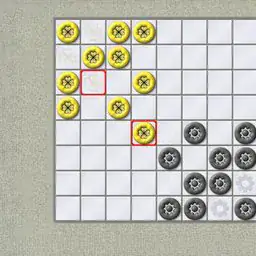
Dots - Duel is basically this super clean abstract strategy game that feels like a cross between Go and a really aggressive game of connect-the-dots. You and another player take turns placing colored dots on a grid, and the whole point is to surround your opponent's dots with a closed line -- vertical, horizontal, or diagonal -- while keeping your own from getting trapped. The visual style is minimal, just a grid and two dot colors, which honestly makes it easier to focus on the strategy. It's got this calm but tense vibe where every move matters because there's no skipping turns, so you're always thinking a few steps ahead. The game can end when the board fills up, or you can set a target number of captured dots to win, which adds a nice pacing option. What's cool is that dots on the edge can't be surrounded, so the border becomes a safe zone you have to fight around. I've played a few rounds with a friend on a 15x15 board, and it gets pretty intense when you're both trying to cut off each other's lines. People who like Chess, Reversi, or any game about territory control will probably get hooked -- it's simple to learn but has real depth. The pass-and-play local mode is perfect for quick matches, and the AI is decent enough to practice against. Just don't expect flashy graphics or music; it's all about the pure tactical duel.
About Dots - duel
So you and a buddy (or the AI) take turns tapping spots on a grid. That's it. One dot per turn, no skipping. Blue goes first, then Red. The whole game is about making loops that trap the other person's dots. You're drawing lines between dots you've placed, and when those lines form a closed shape--vertical, horizontal, or diagonal connections count--you capture anything inside that shape that belongs to the opponent. But there's a catch: if the loop has no enemy dots inside, it's just a dead zone, and you can still place new dots there later. Dots on the edge of the grid can never be surrounded, so those are safe havens.
Your brain's working overtime from move one. You're not just placing dots randomly--you're setting up future traps while blocking theirs. Early games on a small 10x10 board feel fast and frantic, like a quick puzzle. You'll spot obvious surrounds easily. But bump it up to 30x30 and it becomes a war of attrition. The AI has three difficulty levels: Easy, Medium, and Hard. Easy makes obvious mistakes, leaving gaps you can exploit. Hard plays like a chess engine--it sees ten moves ahead and will bait you into building a cage that they'll later use to trap your dots.
The satisfying moment comes when you close a loop and watch five or six of their dots flash and disappear from the board, turning into captured points. The game keeps score of how many you've taken versus how many you've lost. You can set a victory condition--first to capture, say, 20 opponent dots wins--or just play until the grid is completely full. There's no undo button, so every tap feels permanent. Pass-and-play means handing the phone to your friend with a smug look. The online mode matches you against randoms, and the timer adds pressure--you've got 30 seconds per move. Miss your turn and it's forfeit. That timer changes everything, making you think faster and sometimes choke on a simple surround. The game doesn't teach you advanced tactics; you learn them by losing. Like, never start a line near the edge unless you're sure you can close it, because edge dots are immune and your opponent will exploit that. Or how diagonal loops are harder to spot and easier to break. The difficulty builds naturally as you go from clueless newbie to someone who sees the entire grid as a web of potential traps. No tutorials here--just trial, error, and that rush when your plan finally works.
Tips & Tricks
- **Tips & Tricks**
One thing that took me way too long to figure out: the edge of the board is your best friend. Placing dots right on the border means they can never be surrounded, which makes them perfect anchors for building defensive lines. I lost three games in a row before that clicked.
Diagonal lines count for encirclement, and that changes everything. A straight vertical line takes forever to close, but a diagonal loop can trap several opponent dots in just a few moves. Start thinking in diamond shapes early.
Never rush to claim the center. New players always fight over the middle, but that just leaves both of you exposed. Instead, build a small secure zone near an edge first, then expand outward. The opponent will waste moves trying to breach your base while you control the flow 🔍.
Watch out for false encirclements. Sometimes you'll think you've closed a loop, but there's a tiny gap you missed because you didn't check diagonal connections. I once thought I had 10 opponent dots trapped, only to realize a single diagonal space was still open -- and they slipped right through.
If you're playing against the AI, pay attention to its patterns on the 10x10 grid. It likes to mirror your first few moves. Use that against it by setting a trap -- place a dot that looks aggressive but actually sets up a counter-encirclement.
Don't forget you can't skip a turn. That sounds obvious, but when you're stuck with no good moves, a forced placement can break your own formation. Plan for that contingency. Leave yourself a few 'safe' dots on the edge to waste if needed ⏱️.
Finally, the 30x30 grid is a marathon. Pace yourself -- one careless move in the first 50 turns can cost you after 200. I learned that the hard way after an hour-long game ended in a single mistake.




Comments
Please login to leave a comment.